Repository navigation
PSF star selection: apply the manual mask; M33 shows outlier rejection fails where contaminants dominate #993
Description

Summary
Six crowded or extended objects sit in the run-1 PSF star sample: M33, M101, M13, M92, and the Draco and Ursa Minor dwarf spheroidals. Run-1 PSF star selection cuts only on instrument flags (masking.psf_star_mask_veto = instrument_flags_only). That default was a deliberate measure-first choice in #847 (43c32cd): star selection "starts from outlier rejection alone, and MASK_EXT is the configurable pickup if that proves insufficient — write the column, measure the effect, impose it only if the measurement says to." This issue is that measurement, along two axes:
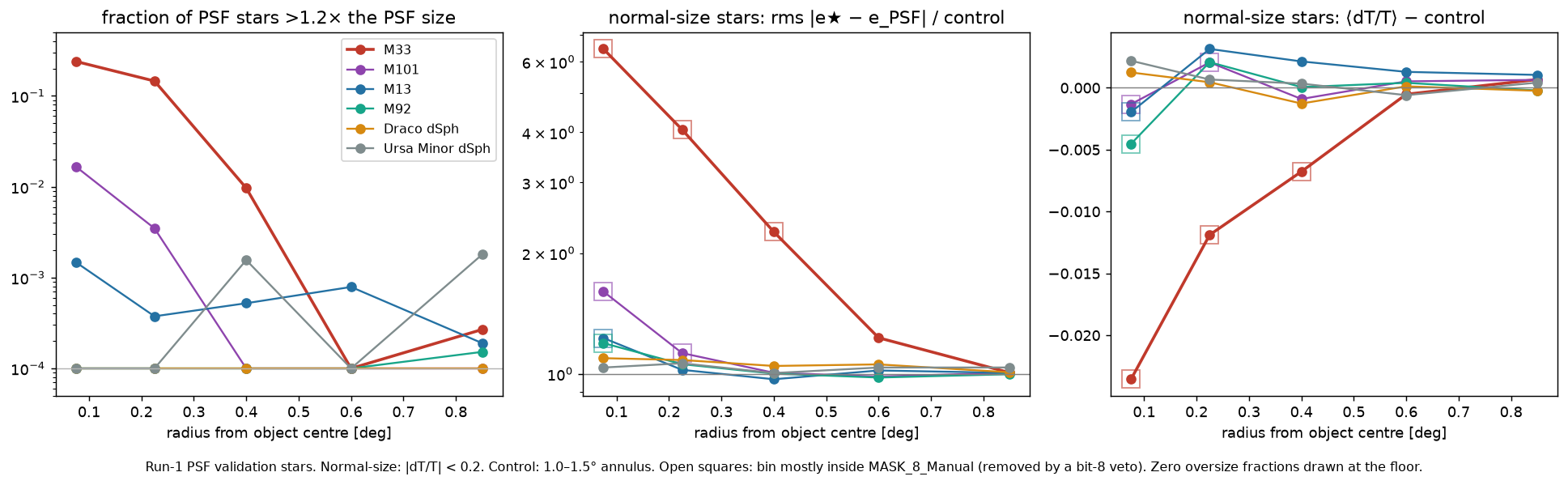
- (b) Is outlier rejection good enough? Yes for crowding; no for M33. In M13, M92, Draco and Ursa Minor, selection keeps real stars and the PSF model fits them like the surrounding field. In M33's inner ~0.5°, selection admits HII regions and clusters (24% of "stars" inside 0.15° are >1.2× the PSF size), and the PSF model itself is biased: normal-size stars come out smaller than the model there. Only M33 corrupts the PSF model.
- (a) Is the manual mask enough? Yes. Applying only
MASK_8_Manualto PSF star selection removes 1,024 of M33's 1,025 oversize detections within 1°, and every radius where the model is biased. No new DSO veto or circle list is needed. Draco and Ursa Minor aren't in the manual mask, and they don't need to be.
Measurement
The sample is the run-1 PSF validation stars (the stars behind ρ/τ). "Normal-size" means |dT/T| < 0.2, and the control is a 1.0–1.5° annulus around each object. The footprint is MASK_8_Manual from the DR6 healsparse mask.
| object | PSF stars within 1° | inside bit 8 | >1.2× PSF size (in bit 8) | normal stars, rms δe vs control, innermost bin | normal stars, ⟨dT/T⟩ − control, innermost bin | corrupts the PSF model? |
|---|---|---|---|---|---|---|
| M33 | 14,754 | 9,125 | 1,025 (1,024) | ×6.4 (<0.15°), ×2.2 (0.3–0.5°) | −0.024 (<0.15°), −0.007 (0.3–0.5°) | yes, inside bit 8 |
| M101 | 4,396 | 409 | 3 (3) | ×1.6 | −0.001 | no; core only, inside bit 8 |
| M13 | 15,090 | 3,218 | 9 (5) | ×1.2 | −0.002 | no (crowding) |
| M92 | 15,086 | 1,836 | 1 (0) | ×1.2 | −0.005 | no (crowding) |
| Draco dSph | 10,593 | 56 | 0 | ×1.1 | +0.001 | no (crowding) |
| Ursa Minor dSph | 7,193 | 25 | 7 (0) | ×1.0 | +0.002 | no (crowding) |
- M33's model is inflated, not just its sample contaminated. Stars of normal size, which are not contaminants by construction, are 2.4% smaller than the model inside 0.15°, 1.2% at 0.15–0.3° and 0.7% at 0.3–0.5°. They're back to the control by 0.5–0.7°. Oversize sources in the training set would pull the model this way (inferred: training stars aren't persisted, but they pass the same selection as the 20% held out for validation). In the cosmic-shear leakage fit, this region carries >99% of the first-bin ρ1/ρ3/ρ4 variance and drives the leakage coefficients α and η negative.
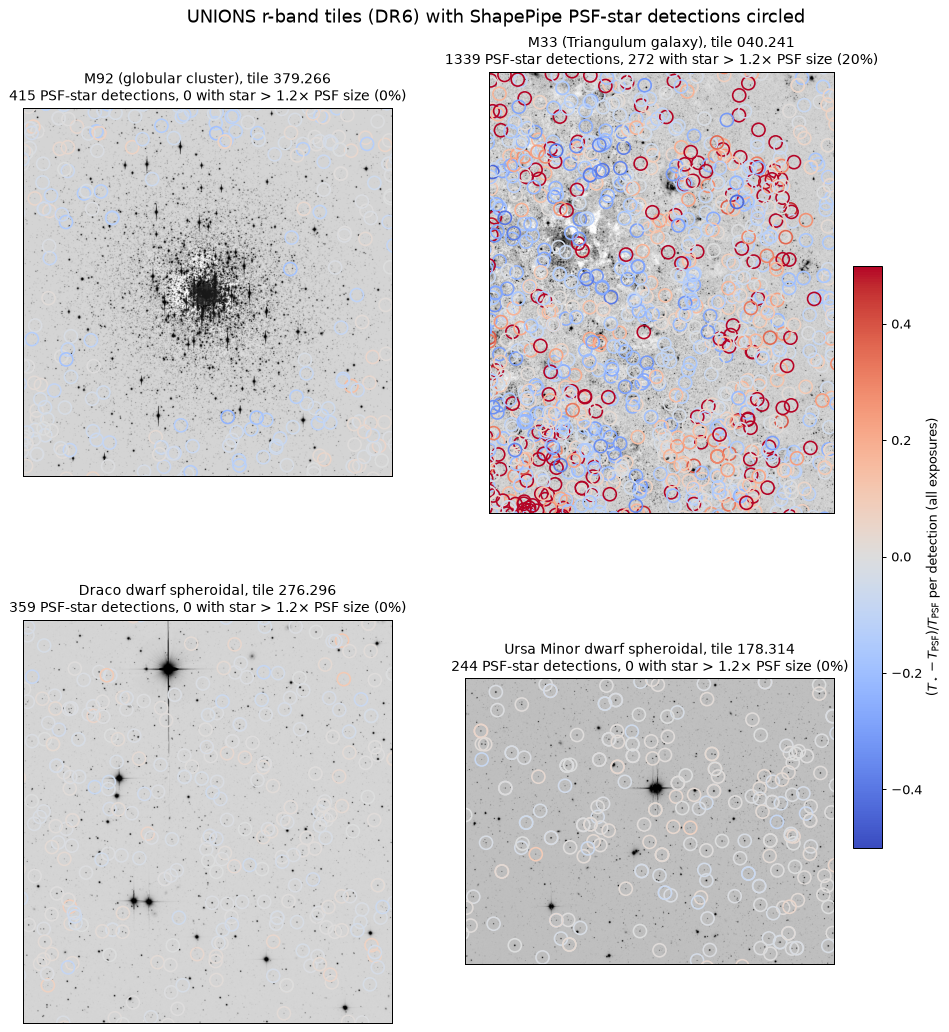
- Crowding is handled. M92, Draco and Ursa Minor are 3–10× overdense in star detections with no oversize detections and normal residuals. In M92's dense core, blending leaves no PSF stars at all.
- Beyond bit 8 around M33: in the 0.5–0.7° ring, outside the manual ellipse (≈0.55° × 0.40°), normal stars show 1.15× the control δe rms with no size bias and no oversize detections. The galaxy side there is 1.25–1.35× overdense in kept galaxies (plausibly outer-disc sources). It's a small effect and outside this issue's star-selection scope, so it's noted rather than acted on.
- Survey-wide, a bit-8 veto removes 51,663 of 10,380,311 PSF stars (0.5%).
Before #846 (eb93838), ShapePipe's internal mask module wrote Messier/NGC discs into the exposure flags, so these regions were vetoed via IMAFLAGS_ISO. Every run-1 campaign descends from eb93838. The NGC/Messier corner-overlap fix (#827) is unrelated.
Proposed change
- ShapePipe, next run: add a
manual_mask_vetooption tomasking.psf_star_mask_vetoand adopt it. Pointmask_queryMASK_PATHSat the bit-8 (manual) map and addMASK_EXT == 0to[MASK:star_selection]. This keeps M33's contaminants out of the PSFEx fit itself, which a downstream veto can't do. The star-body map (star_body_veto) is no substitute: it flags 12.3% of PSF stars. - Run 1, no rerun: downstream, drop PSF stars inside bit 8 before ρ/τ. This replaces hand-placed contamination circles with the same mask the galaxies already use. The biased model in M33 sits inside bit 8, where galaxies are already cut, so no rerun is needed.
Claude on behalf of Cail
Activity
cailmdaley commentedon Oct 30, 2026
Survey-wide search for PSF-star overdensities (run-int1028, full v2 footprint)
I searched the full-area field maps (HEALPix nside 256) for every region where PSF-star detections exceed 1.6 arcmin⁻². Five compact regions turned up. Everything else above that threshold lies along the footprint edges nearest the Galactic plane (|b| ≈ 22–35°), so those are ordinary Milky Way stars.
M101 and M13 don't exceed 1.6 at nside 256, so they don't appear here; this issue already covers them.
At map level, only M33 shows the signature of contamination. Its core has a mean (T★ − T_PSF)/T_PSF of about +1.5 and an elevated |e★ − e_PSF|. M92, Draco and Ursa Minor are dense, but their size and ellipticity residuals match the surrounding field.
The DR6 r-band images, with every PSF-star detection circled (merged across exposures), show the same thing. In yellow are the stars whose median size is >1.2× the PSF model, and these appear only in M33's HII regions and clusters. In M92, the blended core contributes no PSF stars at all.
Implications for the proposed fix:
Claude on behalf of Cail
figures: CosmoStat#993 two-axis profiles and object cutouts
[-]PSF star selection needs a deep-sky-object veto: M33, M101, M13 and M92 enter the PSF star sample[/-][+]PSF star selection: apply the manual mask; M33 shows outlier rejection fails where contaminants dominate[/+]