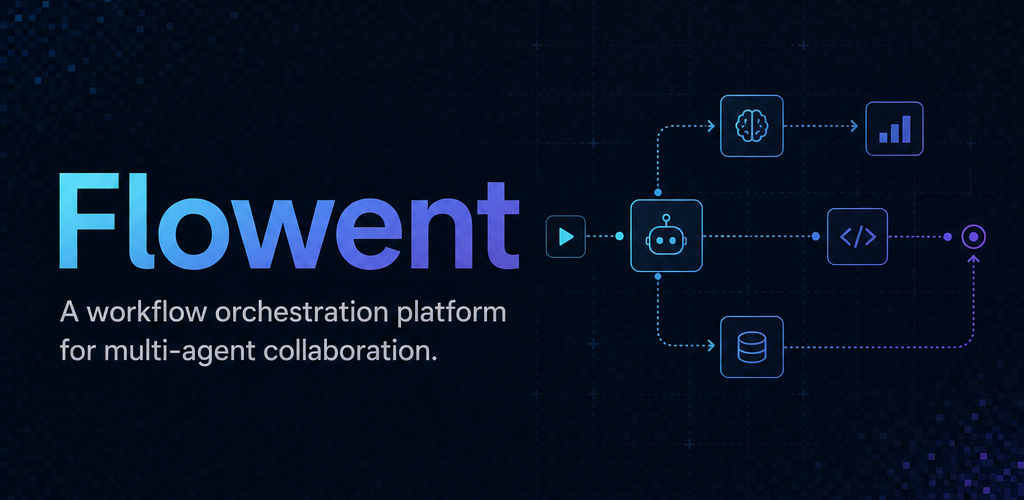







Just say what you need. Flowent gets it done.
Flowent takes your request, works through the context and constraints, and chooses a practical way forward. It can research the problem, write code, call tools, or build a workflow, then keep going until the task is complete or your input is needed.
Flowent turns a conversation into action. It decides what should happen next, uses the capabilities available to it, and follows the work through.
You might ask it to:
- Investigate the available options and recommend one that fits your needs.
- Find a problem in a project, fix it, and verify the result.
- Automate a repetitive task and run it every day.
- Diagnose a failed workflow, repair it, and continue the run.
Flowent combines research, code, files, commands, models, MCP servers, and skills around the same goal. Work that benefits from structure, repetition, or scheduling can become a workflow that Flowent creates and manages for you.
The Workspace keeps every step of the task visible.
In the Workspace, you can follow the conversation, tool calls, command output, progress, and results as one continuous task.
If Flowent turns the task into a workflow, open Workflows to inspect the actual nodes, connections, inputs, and outputs. Ask Flowent to maintain it, or open the canvas and change the properties, connections, and inputs yourself.
Flowent handles the complex work, while you can inspect and edit the execution whenever you want.
Flowent completes simple requests directly and turns structured, repeatable, or scheduled work into workflows. A workflow can accept input, run agents and Python code, call tools, produce output, and run on a timer.
When a workflow fails, Flowent receives the execution details. It can locate the failed step, decide what needs to change, repair the workflow, and verify it again.
The usual loop looks like this:
Tell Flowent what you want to accomplish
        ↓
Flowent considers the options and starts the work
        ↓
Finish directly or create a workflow
        ↓
Run, inspect, and maintain it
        ↓
If something fails, Flowent diagnoses, repairs, and continues
Flowent combines capable local tools with clear security boundaries.
- File tools work within the workspace and explicitly allowed paths.
- Additional access goes through permission review.
- Risk review can stop broad, destructive, or sensitive actions before execution.
- Commands run inside a Bubblewrap sandbox with controlled filesystem access.
- Sandbox failures return to review before any broader retry is considered.
You can give Flowent useful tools while keeping their reach visible and controlled.
Choose the models and services that fit your work. Flowent supports:
- OpenAI-compatible Chat Completions APIs.
- OpenAI Responses APIs.
- Anthropic-compatible APIs.
- Gemini-compatible APIs.
- Custom service addresses and model names.
Provider settings include the selected model, reasoning effort, and context window. Flowent tracks context usage and can compact a long conversation so Flowent can continue with the goal, constraints, and completed work intact.
MCP servers and skills extend Flowent with more tools while your way of working stays the same.
Channels bring Flowent to the places where work already happens.
The Web workspace provides the full conversation, tool, and workflow experience. Telegram is available for sending requests and receiving replies away from the browser, with an approval step for new chat sessions.
Flowent keeps the same identity and task runtime across Channels. Its channel architecture is ready for more integrations alongside Web and Telegram.
Flowent requires Bubblewrap for tool isolation and ripgrep for file search.
Install the system requirements:
sudo apt-get install bubblewrap ripgrepInstall Flowent with npm:
npm install -g flowentOr install it with pip:
pip install flowentStart Flowent:
flowentOpen the address shown in your terminal and tell Flowent what you want to do.
To check whether your system is ready:
flowent doctorYou can also run Flowent with Docker Compose:
docker compose upFlowent is under active development.
Install the repository dependencies and start the development server:
sudo apt-get install bubblewrap ripgrep
pnpm install
uv sync --project backend
pnpm dev
Or run the development container:
docker compose -f docker-compose.dev.yml upFlowent is released under the Apache License 2.0.