
 ███╗   ██╗███████╗██╗  ██╗██╗   ██╗███████╗   ███████╗██╗     ██╗   ██╗
 ████╗  ██║██╔════╝╚██╗██╔╝██║   ██║██╔════╝   ██╔════╝██║     ╚██╗ ██╔╝
 ██╔██╗ ██║█████╗   ╚███╔╝ ██║   ██║███████╗   █████╗  ██║      ╚████╔╝
 ██║╚██╗██║██╔══╝   ██╔██╗ ██║   ██║╚════██║   ██╔══╝  ██║       ╚██╔╝
 ██║ ╚████║███████╗██╔╝ ██╗╚██████╔╝███████║   ██║     ███████╗   ██║
 ╚═╝  ╚═══╝╚══════╝╚═╝  ╚═╝ ╚═════╝ ╚══════╝   ╚═╝     ╚══════╝   ╚═╝





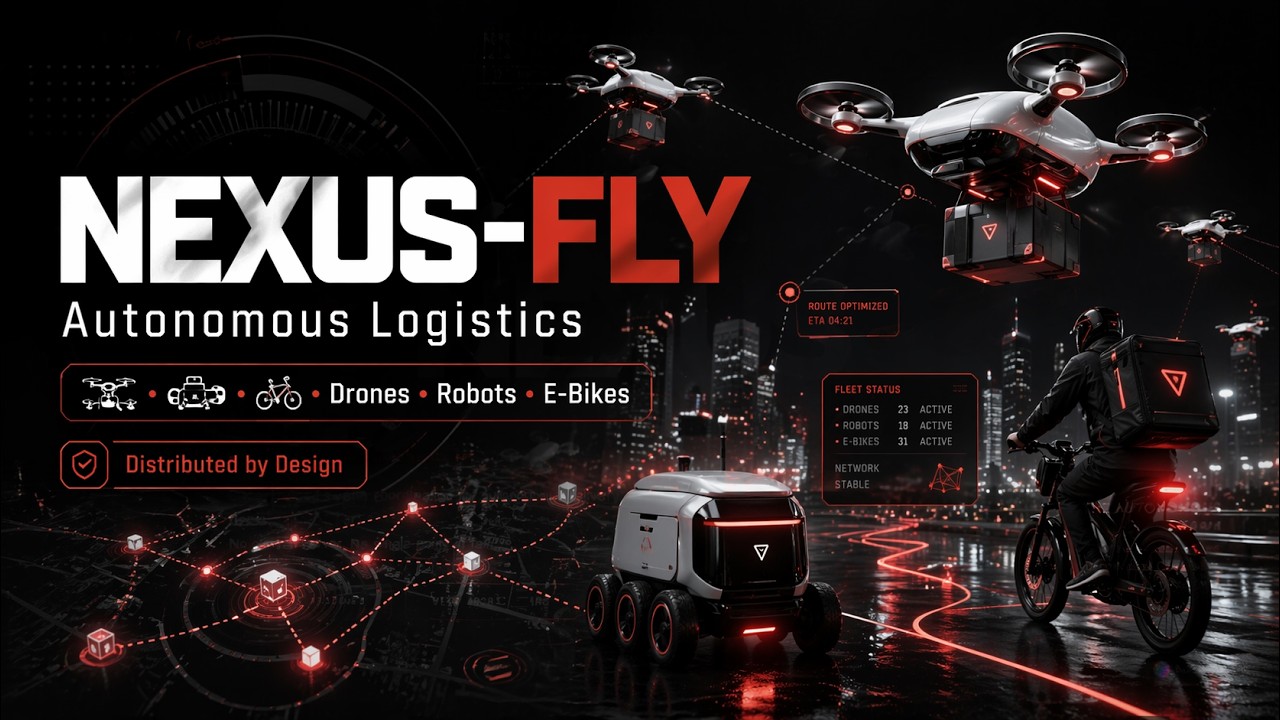
Click the image above to watch the pitch video.
Nexus-Fly is a decentralized coordination platform for autonomous delivery fleets, designed to show how drones, ground robots, and e-bikes can operate as a single resilient network without relying on a central orchestrator. The project addresses one of the most important challenges in autonomous logistics: coordinating heterogeneous agents in real time in a way that is auditable, fault-tolerant, and reproducible.
This organization includes:
- The core Rust implementation and fully functional MVP binaries
- A deterministic local execution flow and reproducible operational scenarios
- A live execution server for observing the system running continuously
- A React front-end for architecture presentation and system visualization
- A Docker-containerized environment, ready for fast deployment and frictionless validation
This document is intended as a concise and practical guide for reviewing the project efficiently, technically, and reproducibly.
- Project overview and architecture:
README.md - Rust core, MVP flow, and execution details:
Codigo-Rust/README.md - Front-end presentation layer:
front-end/README.md
Use this checklist to validate the project's main claims during a short review session.
- Consensus ordering: confirm that critical events are applied consistently and identically across nodes or simulated executions.
- Auction determinism: verify that the winner selection logic produces the exact same result across runs and nodes.
- Agent failure handling: trigger an inactive or silent agent and observe how the system detects the failure and re-routes the workflow through re-auction.
- Handoff flow: validate that a delivery can be transferred between agents and that the ledger reflects the transition correctly.
- Review the logs and confirm the expected operational sequence:
OrderCreated -> AuctionBid -> AuctionWinner -> PickedUp -> InTransit -> Delivered
- Run
mvp_demoand verify that a complete delivery lifecycle executes end-to-end without manual intervention. - Run
mvp_serverand confirm that the system stays active, continuously generating activity and real-time logs.
- Confirm that the front-end loads correctly and communicates the architecture, capabilities, and system scenarios clearly.
To avoid native build issues, the Rust execution flow should be run inside the provided Docker development container.
From the repository root:
docker compose build
docker compose up -d vertex-devdocker compose exec vertex-dev bashInside the container:
cargo run --bin mvp_demoInside the container:
cargo run --bin mvp_server- The Rust test suite is expected to pass successfully (61 tests in the current codebase). You can validate this by running:
cargo test- The native tashi-vertex dependency requires a Linux environment; the Docker container already provides everything needed.
- Because the project is already containerized with Docker, it is straightforward to deploy, reproduce, and inspect without dealing with local environment inconsistencies.
If review time is limited, this is the recommended flow:
- Run
cargo run --bin mvp_demo - Confirm the complete delivery lifecycle in the logs
- Run
cargo run --bin mvp_server - Observe continuous system activity, event generation, and live behavior
- Inspect auction logic, handoffs, and settlement behavior
- Trigger or review an agent failure and re-auction path
- Open the front-end (
npm run dev) to inspect architecture and visual summaries (Optional, but useful for context and presentation)
Use this repository's Issues to report findings, attach logs, or request clarification.
For technical questions about execution or architecture, refer to:
Codigo-Rust/README.md- or open an Issue in this repository.
If a guided run-through or a packaged set of execution logs is needed, it can be prepared quickly.
These are some of the reasons Nexus-Fly represents a strong, technically mature, and highly inspectable submission:
-
Deterministic by design Auction behavior, event ordering, and state transitions are reproducible across nodes and executions. What is observed is not dependent on arbitrary or manual conditions.
-
Reproducible functional workflow The local execution path (
mvp_demo) runs a full delivery lifecycle end-to-end without requiring external services, making validation fast and reliable. -
Live execution server for continuous observation
mvp_serverallows the system to be observed as an ongoing functional process, generating activity and logs in real time. -
Quality backed by tests The current Rust test suite (61 tests) covers domain logic, auctions, handoffs, recovery flows, and core system behavior.
-
Resilience-first architecture Nexus-Fly removes the single point of failure by replacing centralized orchestration with a coordination layer based on consensus-ordered events.
-
Direct, frictionless deployment The project is already prepared to run inside a Dockerized environment, which reduces setup overhead and makes review fast, clean, and consistent.
-
Clear observability Logs and execution flow make it possible to verify exactly how an order is created, assigned, transferred, and completed.
-
Ready to run in minutes The project can be built, launched, and inspected quickly, allowing attention to stay on system behavior rather than environment setup.
-
Real technical substance The system combines distributed systems, robotics, BFT consensus, multi-agent coordination, and autonomous logistics in a modular and extensible architecture.
Nexus-Fly represents a concrete and functional vision of how autonomous coordination should work in the future. It combines reproducibility, resilience, traceability, and architectural clarity into a system that can already be deployed, executed, and inspected with minimal setup.
Rather than presenting only a concept, Nexus-Fly provides a running functional codebase that shows how drones, ground robots, and e-bikes can operate as a distributed logistics network without relying on a central orchestrator. Its architecture demonstrates a credible path toward real-world autonomous fleet coordination: distributed, fault-tolerant, auditable, and built for heterogeneous agents.
Nexus-Fly is not just a proposal — it is functional code already running.
