中文简体 | Español | Português | 日本語 | Deutsch








Policy-governed agent runtime for production. Same agent. Secure runtime.
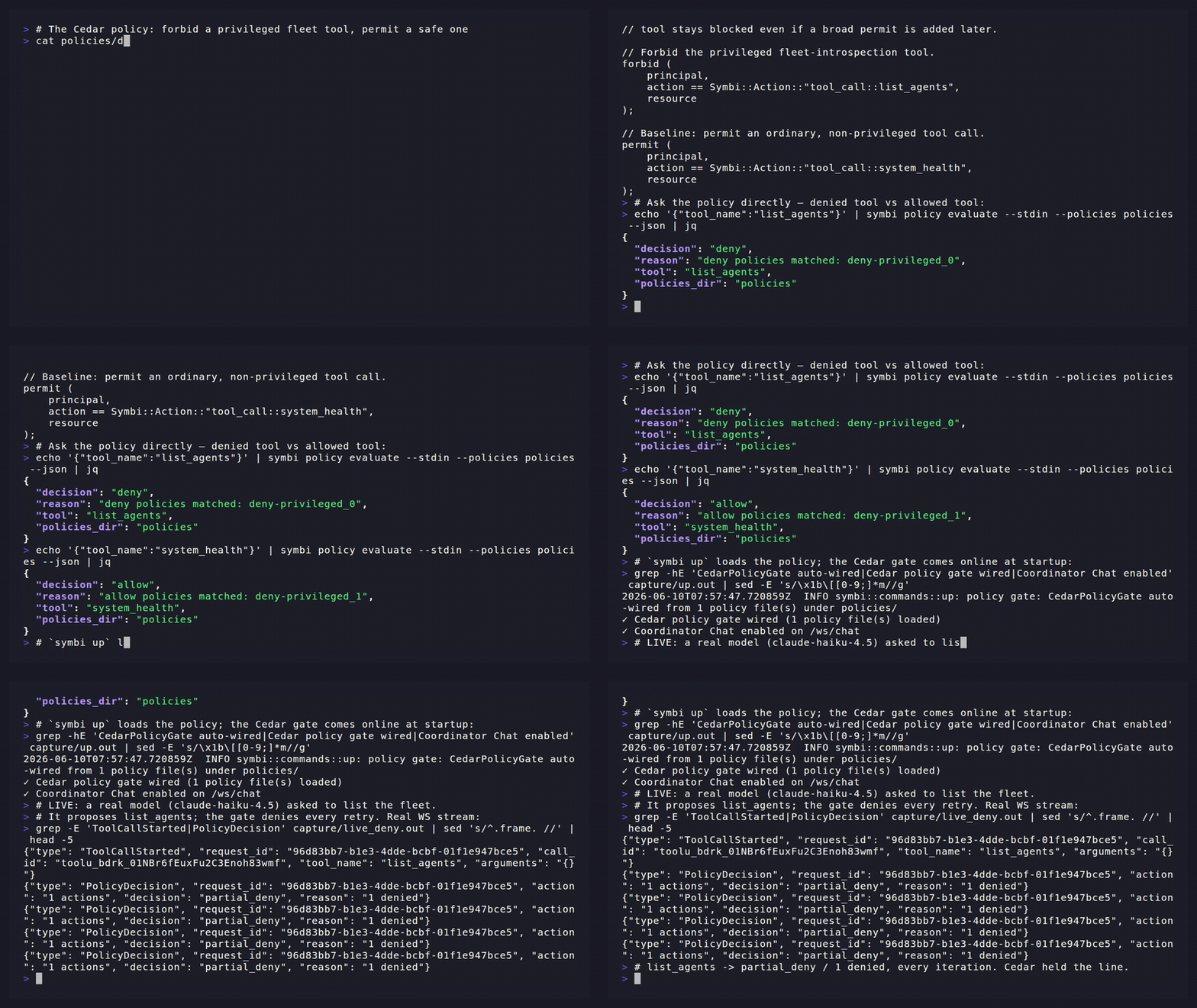
What you're seeing: a real model (
claude-haiku-4.5) asks to list the agent fleet. A Cedarforbidrule denies the call on every retry — no code change, just policy. Reproduce it in one command ↓ · ▶ Full walkthrough
Symbiont is a Rust-native runtime for executing AI agents and tools under explicit policy, identity, and audit controls.
Containment: See the operator guide for the CLI, TUI, chat, audit and scheduling changes in 1.21.0. It includes migration steps and the remaining gaps; full containment across all entry points is not established.
Most agent frameworks focus on orchestration. Symbiont focuses on what happens when agents need to run in real environments with real risk: untrusted tools, sensitive data, approval boundaries, audit requirements, and repeatable enforcement.
AI agents are easy to demo and hard to trust.
Once an agent can call tools, access files, send messages, or invoke external services, you need more than prompts and glue code. You need:
- Policy enforcement for what an agent may do — built-in DSL and Cedar authorization
- Tool verification so execution is not blind trust — SchemaPin cryptographic verification of MCP tools
- Tool contracts for how tools execute — ToolClad declarative input validation, scope enforcement, and injection prevention
- Agent identity so you know who is acting — AgentPin domain-anchored ES256 identity
- Sandboxing for risky workloads — choose Docker, gVisor (
runsc), or Firecracker microVM per agent - Audit trails for what happened and why — cryptographically tamper-evident logs
- Approval gates for sensitive actions — human review before execution when policy requires it
Symbiont is built for that layer.
Optional governed improvements let operators evaluate versioned workflow instructions against signed trial evidence, approve an exact candidate and pin it for explicitly selected runs. Existing agents do not opt in automatically. The OSS lifecycle includes offline evaluation, rollback and independently verifiable exports; organization-wide release management is separate from these runtime controls.
Symbiont is the reference implementation of the Open Agent Trust Stack (OATS) — an open specification (CC BY 4.0) for securing AI agent execution through structural enforcement rather than post-hoc interception ("define what is permitted and make everything else structurally inexpressible"). The OATS spec is grounded in Symbiont's production operational experience and Symbiont's design tracks the OATS layers directly:
| OATS Layer | Symbiont mapping |
|---|---|
| Layer 1 — ORGA Loop (typestate-enforced Observe-Reason-Gate-Act) | crates/runtime/src/reasoning/ — typestate-enforced phases; policy gate is unskippable at compile time. See Wanger 2026 / DOI 10.5281/zenodo.19896446. |
| Layer 2 — Tool Contracts | ToolClad declarative .clad.toml manifests + the agent_summary typestate fence in crates/runtime/src/toolclad/. See Wanger 2026 / DOI 10.5281/zenodo.19957596. |
| Layer 3 — Identity | SchemaPin for MCP tools + AgentPin ES256 domain-anchored agent identity. |
| Layer 4 — Policy Engine | Cedar policy gate (crates/runtime/src/reasoning/cedar_gate.rs) + CommunicationPolicyGate for inter-agent calls; both fail-closed by default since v1.14.0. |
| Layer 5 — Audit Journal | Required protected, hash-chained, Ed25519-signed journals for ordinary/managed CLI, HTTP, scheduled ORGA and default DSL reason()/tool_call() runs; other default paths still need migration. See run audit. |
Symbiont conforms to OATS Extended (C1–C7 + E1–E8). The empirical comparison of structural-enforcement runtimes that informs the spec is Wanger 2026 / DOI 10.5281/zenodo.20043247.
For native isolation on a supported Linux desktop, start with:
symbi init --sandbox landlock --profile assistant --dir my-agent
cd my-agent
symbi doctor
This path needs Landlock ABI 6+ and a systemd user manager with cgroup v2
CPU/memory/PID delegation and DelegateSubgroup support. It automatically starts
supervision and checks a restricted worker's execution and cleanup, without
Docker or a manually installed service unit. See the
Landlock supervision guide and governed Linux development for configuration and the current
supported execution routes.
For guided read-only repository review with an installed Claude Code, use
symbi init --sandbox landlock --profile dev-agent --dir review-control. It asks
for a separate source repository, executable and Messages-compatible inference
settings, then generates the read/list/search tools and their policies. Follow
the printed doctor and review commands. See the
developer onboarding guide
for noninteractive flags and prerequisites.
A Cedar forbid blocks a privileged tool while a safe one passes. Copy-paste this against the published image (no clone, no build):
docker run --rm --entrypoint sh ghcr.io/thirdkeyai/symbi:latest -c '
mkdir -p /tmp/p && cat > /tmp/p/policy.cedar <<EOF
forbid(principal, action == Symbi::Action::"tool_call::list_agents",   resource);
permit(principal, action == Symbi::Action::"tool_call::system_health", resource);
EOF
echo "{\"tool_name\":\"list_agents\"}"   | symbi policy evaluate --stdin --policies /tmp/p --json
echo "{\"tool_name\":\"system_health\"}" | symbi policy evaluate --stdin --policies /tmp/p --json'{"decision":"deny","reason":"deny policies matched: policy_0","tool":"list_agents", ...}
{"decision":"allow","reason":"allow policies matched: policy_1","tool":"system_health", ...}That's the same Cedar gate the runtime wires into the live reasoning loop — exactly the denial shown in the demo above.
Tool contracts are declarative. Scaffold one, validate it, and see exactly what would run and which Cedar action gates it — all offline:
symbi tools init greet
symbi tools validate
symbi tools test greet --arg target=example
greet OK
✓ target (string): example → OK
Command: greet example
Cedar: Tool::Greet / execute_tool
[dry run — command not executed]
Argument types, scope limits and injection checks are enforced before anything executes, and the dry run names the Cedar action that gates the call.
Point OPENAI_BASE_URL at any OpenAI-compatible server. With
Ollama on its default port:
export OPENAI_API_KEY=ollama
export OPENAI_BASE_URL=http://localhost:11434/v1
export CHAT_MODEL=llama3.1

symbi init --no-interact
symbi run assistant --input '{"query":"hello"}'
→ Running agent: assistant (agents/assistant.symbi)
✓ Cedar policy gate wired (1 policy file(s) loaded)
Hello from the local model.
--- 1 iterations, 2 tokens, terminated: Completed ---
# Linux / macOS — installs the `symbi` binary to /usr/local/bin
curl -fsSL https://symbiont.dev/install.sh | bash
symbi --help
The installer fetches the prebuilt release binary for your platform. Pin a version with bash -s -- --version v1.16.0 or change the target with --dir. Prefer Docker or building from source? Both are below.
Already have a Rust toolchain (1.89+)? Install from crates.io instead:
cargo install symbi
symbi --help- Docker (recommended) or Rust 1.89+
# 1. Create the project in the current directory.
#    Generates symbiont.toml, agents/, policies/, docker-compose.yml, and
#    a .env with a freshly generated SYMBIONT_MASTER_KEY.
docker run --rm -v $(pwd):/workspace ghcr.io/thirdkeyai/symbi:latest \
  init --profile assistant --no-interact --dir /workspace

# 2. Start the runtime. Reads .env automatically.
docker compose up
That's it — Runtime API on http://localhost:8080, HTTP Input on http://localhost:8081.
Use symbi init --catalog list (or the Docker equivalent) to browse pre-built agents.
# Ad-hoc runtime without a project (ephemeral, no master key)
docker run --rm -p 8080:8080 -p 8081:8081 ghcr.io/thirdkeyai/symbi:latest up

# MCP server only
docker run --rm -p 8080:8080 ghcr.io/thirdkeyai/symbi:latest mcp

# Parse an agent definition (`.symbi`; legacy `.dsl` also accepted)
docker run --rm -v $(pwd):/workspace ghcr.io/thirdkeyai/symbi:latest \
dsl -f /workspace/agent.symbicargo build --release
./target/release/symbi --help
# Scaffold a project locally, then start the runtime
./target/release/symbi init --profile assistant --no-interact
./target/release/symbi upFor production deployments, review
SECURITY.mdand the deployment guide before enabling untrusted tool execution.
Prefer a task-shaped starting point over a blank project? symbi new scaffolds
around a template:
symbi new --list                     # webhook-min, webscraper-agent, slm-first, rag-lite
symbi new <template> <project-name>symbi shell auto-loads agents from ./agents on startup — TOML manifests with
name / description / system_prompt / optional tools. Talk to the
orchestrator in natural language; it delegates sub-tasks to the right agent
through the governed communication path (every delegation is policy-checked and
audited). Manage the fleet with /agents list, /agents load <dir>, and
/agents reload. .symbi and legacy .dsl declarations can register conversational fleet agents.
Explicit sandbox declarations remain refused pending canonical per-agent boundary
binding; this fleet surface does not execute their behavior steps.
You can also address one agent directly: @<name> <message> holds a governed,
multi-turn conversation with that agent (its own thread, separate from the
orchestrator), or /agent use <name> focuses the prompt on it until
/agent clear. The footer shows the current addressee (→ ORCH or → @name).
Direct messages are policy-checked and audited exactly like orchestrator-routed
delegation.
The orchestrator also has governed tools: read-only read_file / search
(relative to explicit /workspace data mounts), and mutating edit_file,
save_artifact plus an optional shell. File and command effects use the selected
Docker/gVisor worker; each turn requires protected signed audit.
Mutating tools require human approval — each call is held in the Gate panel
(Ctrl+G opens the queue, Enter reviews the complete request, then a approves
or d denies; the held action fails closed on expiry). shell
(arbitrary command execution) is off by default and only available when the
shell is started with --allow-shell. --yes does not bypass runtime approval.
See workspace setup and audit UX.
Symbiont separates agent intent from execution authority:
- Agents propose actions through the reasoning loop (Observe-Reason-Gate-Act)
- The runtime evaluates each action against policy, identity, and trust checks
- Policy decides — allowed actions execute; denied actions are blocked or routed for approval
- Everything is logged — tamper-evident audit trail for every decision
Model output is never treated as execution authority. The runtime controls what actually happens.
An agent attempts to call an unverified MCP tool. The runtime:
- Checks SchemaPin verification status — tool signature is missing or invalid
- Evaluates Cedar policy —
forbid(action == Action::"tool_call") when { !resource.verified } - Blocks execution and logs the denial with full context
- Optionally routes to an operator for manual approval
No code change required. The policy governs execution.
metadata {
    version = "1.0.0"
    description = "Validate a dataset and return a quality report"
}

agent data_validator(data: DataSet) -> ValidationReport {
    capabilities = ["data_validation", "schema_checking"]

    policy data_quality {
        allow: ["read_data", "validate_schema"]
            if data.source.trusted == true
        deny: ["write_data", "network_access"]

        require: {
            input_sanitization: true
        }

        audit: {
            log_level: "info",
            include_statistics: true
        }
    }

    with memory = "ephemeral", privacy = "high", sandbox = "Tier1" {
        return validate(data);
    }
}
See the DSL guide for the full grammar including metadata, schedule, webhook, and channel blocks.
File extension: Symbiont agent definitions use
.symbias their canonical extension (e.g.agents/assistant.symbi). The legacy.dslextension continues to be parsed indefinitely for backward compatibility, but new projects scaffolded withsymbi initand all examples in this repo use.symbi.
| Capability | What it does |
|---|---|
| Policy engine | Fine-grained Cedar authorization for agent actions, tool calls, and resource access |
| Tool verification | SchemaPin cryptographic verification of MCP tool schemas before execution |
| Tool contracts | ToolClad declarative contracts with argument validation, scope enforcement, and Cedar policy generation |
| Agent identity | AgentPin domain-anchored ES256 identity for agents and scheduled tasks |
| Reasoning loop | Typestate-enforced Observe-Reason-Gate-Act cycle with policy gates and circuit breakers |
| Sandboxing | Docker, gVisor (runsc), or Firecracker microVM — selectable per agent via the DSL with { sandbox = ... } block |
| Audit logging | Tamper-evident logs with structured records for every policy decision |
| Secrets management | Vault/OpenBao integration, AES-256-GCM encrypted storage, scoped per agent |
| MCP integration | Native Model Context Protocol support with governed tool access |
Additional capabilities: threat scanning for tool/skill content (40 rules, 10 attack categories), cron scheduling, persistent agent memory, hybrid RAG search (LanceDB/Qdrant), webhook verification, delivery routing, OTLP telemetry, HTTP security hardening, and governance plugins for Claude Code and Gemini CLI. See the full documentation for details.
Representative benchmarks are available in the benchmark harness and threshold tests.
Symbiont is designed around a simple principle: model output should never be trusted as execution authority.
Actions flow through runtime controls:
- Zero trust — all agent inputs are untrusted by default
- Policy checks — Cedar authorization before every tool call and resource access
- Tool verification — SchemaPin cryptographic verification of tool schemas
- Sandbox boundaries — pick the isolation level per agent: Docker (default), gVisor (
runscsyscall filter), or Firecracker (microVM) - Operator approval — human review gates for sensitive actions
- Secrets control — Vault/OpenBao backends, encrypted local storage, agent namespaces
- Audit logging — cryptographically tamper-evident records of every decision
If you are executing untrusted code or risky tools, do not rely on a weak local execution model as your only boundary. See SECURITY.md and the security model docs.
| Crate | Description |
|---|---|
symbi |
Unified CLI binary |
symbi-runtime |
Core agent runtime and execution engine |
symbi-dsl |
DSL parser and evaluator |
symbi-channel-adapter |
Slack/Teams/Mattermost adapters |
repl-core / repl-proto / repl-cli |
Interactive REPL and JSON-RPC server |
repl-lsp |
Language Server Protocol support |
symbi-shell |
Interactive TUI for authoring, orchestration, and remote attach (beta) |
symbi-a2ui |
Admin dashboard (Lit/TypeScript, alpha) |
symbi-session |
Multiparty session-type projection + runtime protocol monitor for inter-agent choreography (experimental; off by default, enable with --features session) |
Governance plugins: symbi-claude-code | symbi-gemini-cli
If you are evaluating Symbiont for production, start with the security model and getting started docs.
Official client SDKs for integrating with the Symbiont runtime from your application:
| Language | Package | Repository |
|---|---|---|
| JavaScript/TypeScript | symbiont-sdk-js | GitHub |
| Python | symbiont-sdk | GitHub |
Production recommendation: The JS and Python SDKs are HTTP clients intended for application integration and prototyping. For production agent workloads, we recommend building directly on the Rust implementation to leverage Symbiont's full typestate-driven safety guarantees — capability authorization, policy enforcement, and lifecycle invariants enforced at compile time rather than runtime. Dynamic-language clients can only verify these properties after a request crosses the runtime boundary.
- Community Edition (Apache 2.0): Core runtime, DSL, policy engine, tool verification, sandboxing, agent memory, scheduling, MCP integration, RAG, audit logging, and all CLI/REPL tooling.
- Enterprise Edition (commercial): Compliance audit exports, AI-powered tool review, encrypted multi-agent collaboration, monitoring dashboards, and dedicated support. (All three sandbox backends — Docker, gVisor, and Firecracker — are OSS.)
Contact ThirdKey for enterprise licensing.