Runnable samples for Jev, TypeSafe AI's System One model. You send it state and a list of questions, each question carrying its possible answers. It sends back the answers with no prose around them, so your code branches on a value instead of parsing one out of a paragraph.
Every sample is a small self-contained project under samples/, and you can run each one against your own files.
| Sample | What it does |
|---|---|
| readme-check | Reads a README from disk or a GitHub URL, asks five questions about it in one call, and explains every number it prints. Uses all three primitives: Choice, Score and Noul. |
| agents-md-readiness | Scores an AGENTS.md or CLAUDE.md against the agents.md format: seventeen questions in one call, a padded markdown table, one weighted readiness score, and a JSON report per document. Ships scored runs for eleven open-source repos in data/, plus a Go port that compiles the same check into one static binary for a CI runner without Python. |
Each sample keeps its Jev payload in questions.yml: the model pin, the state budget, every question with the label it prints under, and what each answer is worth toward the score. The Python reads that file and does the arithmetic, so changing a question or a weight is a data change and changing a threshold is a code change.
More samples to come, one folder each.
The poster covers the three question types, the shape of a request and its response, where Jev sits against a frontier model on latency, the failure modes, and the patterns worth copying. Both pages live in my-ai-assets, and this README embeds them from there, so one copy serves both repos.
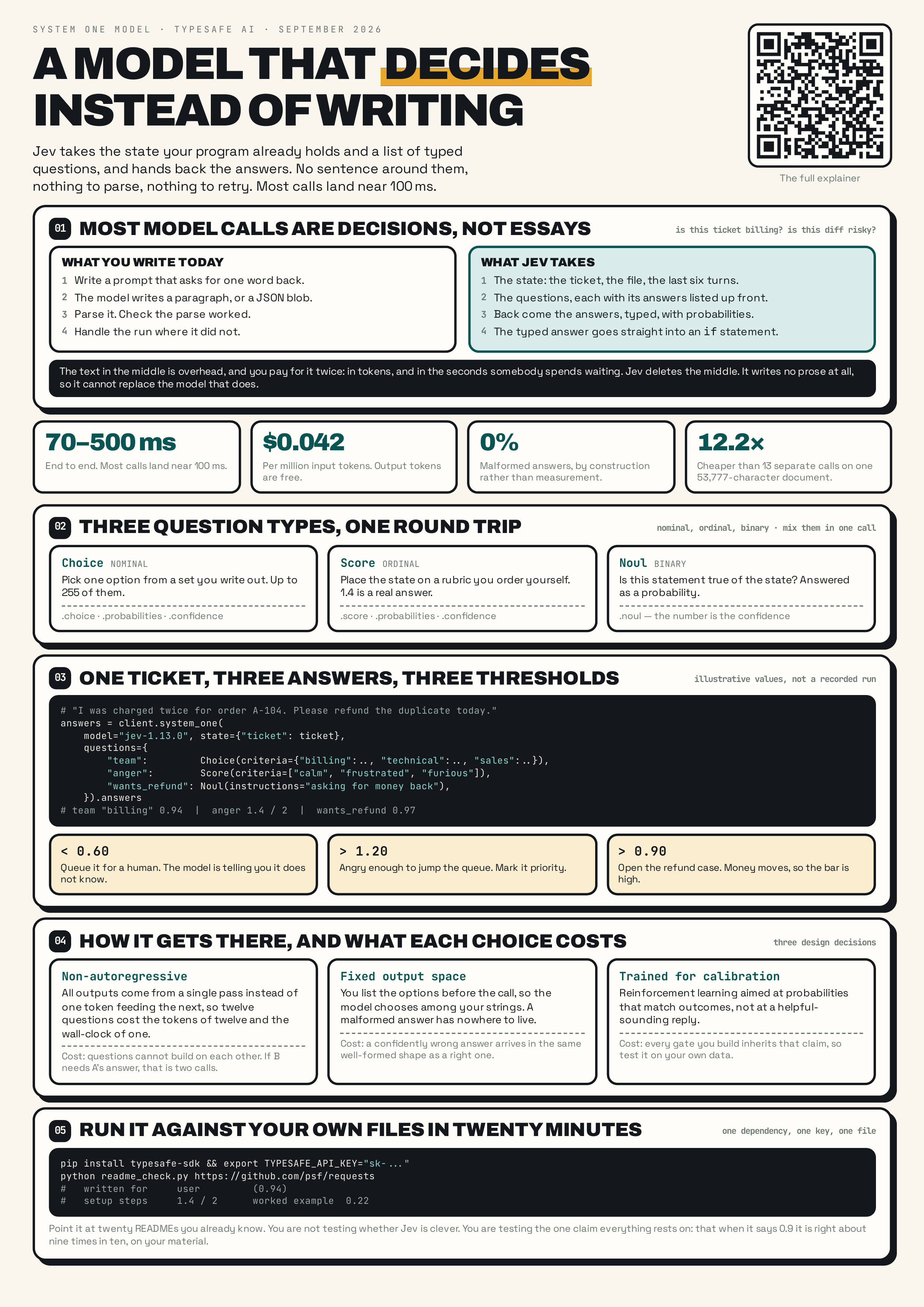
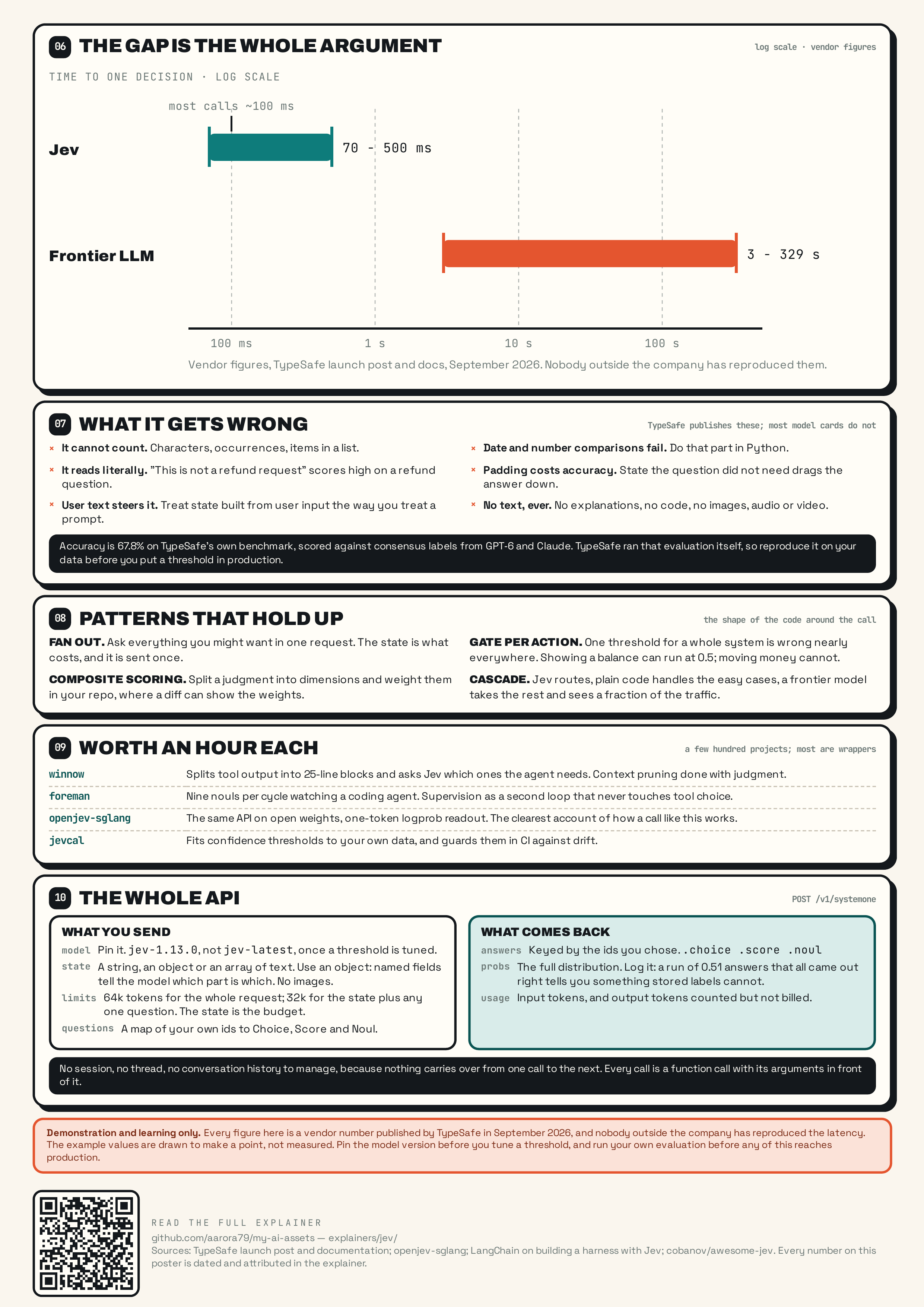
Read the explainer for a more detailed version: Jev: a model that decides instead of writing. The same poster prints from a two-page A4 PDF, duplex on the long edge with no scaling.
- Python 3.11 or newer
- uv for dependencies and running
- A TypeSafe API key in
TYPESAFE_API_KEY
Each sample reads TYPESAFE_API_KEY from the environment, and falls back to a .env file beside the sample or at the repo root, logging which file it read. Parsing that file takes fourteen lines of standard library, so no sample carries a dependency for it.
cp .env.example .env         # put your key in it, and the samples find it

# the environment still wins, for a different key or a throwaway one
export TYPESAFE_API_KEY="your-key"
The curl calls below read the environment, so export the key for those.
One endpoint does everything: POST https://api.typesafe.ai/v1/systemone. The body holds model, state and questions. This call asks all three question types at once about one support ticket, which is every option the model takes.
export TYPESAFE_API_KEY="your-key"

curl -s https://api.typesafe.ai/v1/systemone \
  -H "Authorization: Bearer $TYPESAFE_API_KEY" \
  -H "Content-Type: application/json" \
  -d '{
    "model": "jev-1.13.0",
    "state": {
      "ticket": "I have been charged twice for order A-104. The second charge hit this morning. I have emailed twice and nobody has replied. Please refund the duplicate today."
    },
    "questions": {
      "team": {
        "type": "choice",
        "instructions": "Which team should handle this ticket",
        "criteria": {
          "billing": "Charges, invoices, refunds",
          "technical": "Something is broken or behaving wrong",
          "sales": "Pricing, plans, account changes"
        }
      },
      "anger": {
        "type": "score",
        "instructions": "How angry the customer sounds",
        "criteria": [
          "Calm, stating facts",
          "Frustrated but civil",
          "Furious, threatening to leave"
        ]
      },
      "wants_refund": {
        "type": "noul",
        "instructions": "The customer is asking for money back"
      }
    }
  }' | python3 -m json.tool
The response, from a run on 19 September 2026:
{
    "model": "jev-1.13.0",
    "answers": {
        "team": {
            "type": "choice",
            "choice": "billing",
            "confidence": 1.0,
            "probabilities": {
                "technical": 0.0,
                "sales": 0.0,
                "billing": 1.0
            }
        },
        "anger": {
            "type": "score",
            "score": 1.0,
            "confidence": 1.0,
            "legend": {
                "0": "Calm, stating facts",
                "1": "Frustrated but civil",
                "2": "Furious, threatening to leave"
            },
            "probabilities": {
                "0": 0.0,
                "1": 1.0,
                "2": 0.0
            }
        },
        "wants_refund": {
            "type": "noul",
            "noul": 0.99
        }
    },
    "usage": {
        "input_tokens": 439,
        "output_tokens": 71
    }
}
A choice answer names one of your options and shows where the rest of the probability mass went, and this ticket left none of it elsewhere. A score answer carries a legend mapping each rubric level back to the text you wrote, so 1.0 means "frustrated but civil". A noul answer is one number, and 0.99 is both the answer and the confidence.
TypeSafe priced input tokens only in September 2026, at $0.042 per million, so these 439 input tokens cost about $0.000018. The API still counts output tokens, and reported 71 here.
Each sample folder is its own uv project, so uv run resolves its dependencies on first use.
cd samples/readme-check
uv run readme_check.py --help
uv run readme_check.py https://github.com/psf/requests

cd ../agents-md-readiness
uv run agents_md_readiness.py --help
uv run agents_md_readiness.py https://github.com/apache/airflow| Type | Asks | Returns |
|---|---|---|
Noul |
Is this statement true of the state? | .noul, a probability from 0 to 1. No separate confidence field, because the number is the confidence. |
Choice |
Which of these options fits? | .choice, .probabilities over every option, .confidence. |
Score |
Where on this ordered rubric does it sit? | .score, which lands between levels, plus .legend mapping each level back to your text, .probabilities, .confidence. |
Keep each question atomic, asking about one thing. "Is this ticket urgent and about billing?" has no honest answer when the ticket is urgent and about something else, and the model answers half your question without telling you which half. When a judgment has several parts, weight them in your own code, where you can read the weights in a diff.
These samples come out of an explainer on how Jev works and what to measure before you trust a confidence threshold: Jev: a model that decides instead of writing.
Worth reading before you build a gate on top of Jev:
- TypeSafe documentation for the primitives, state shape and HTTP API
- typesafe-sdk-python, the official Python SDK
- openjev-sglang, an open reproduction of the call shape on weights you can host
- jevcal, which turns a confidence threshold from a guess into a measurement
Accuracy is 67.8% on TypeSafe's own benchmark, published September 2026, and nobody outside the company has reproduced the latency. Measure both on your own data before a threshold guards anything that matters.