Own your agents, don't rent them. Agentis is a self-hosted, open-source multi-harness dashboard that runs on your machine today with Claude Code, Codex, Cursor, Antigravity, Hermes, OpenClaw, or your own HTTP and local models underneath (a harness of our own is coming next). Those tools forget everything the moment the process dies, and most of them phone your work home to someone else's cloud while they run. Agentis doesn't. Import the agents you already run into one dashboard, give them a permanent Brain of memory and skills, swap the model underneath them anytime, and ship what they build as real agentic apps powered by a workflow engine. No lock-in.
Runs on your machine. Keeps every agent's memory. Never routes your work through our servers.
Agents should not disappear when a vendor changes, a subscription ends, or a local process restarts. Agentis gives them durable identity, memory, orchestration, tools, approvals, and a live product surface they can operate with you.





Status: pre-release (0.2.x). Agentis is already usable, but APIs may still change before 1.0.

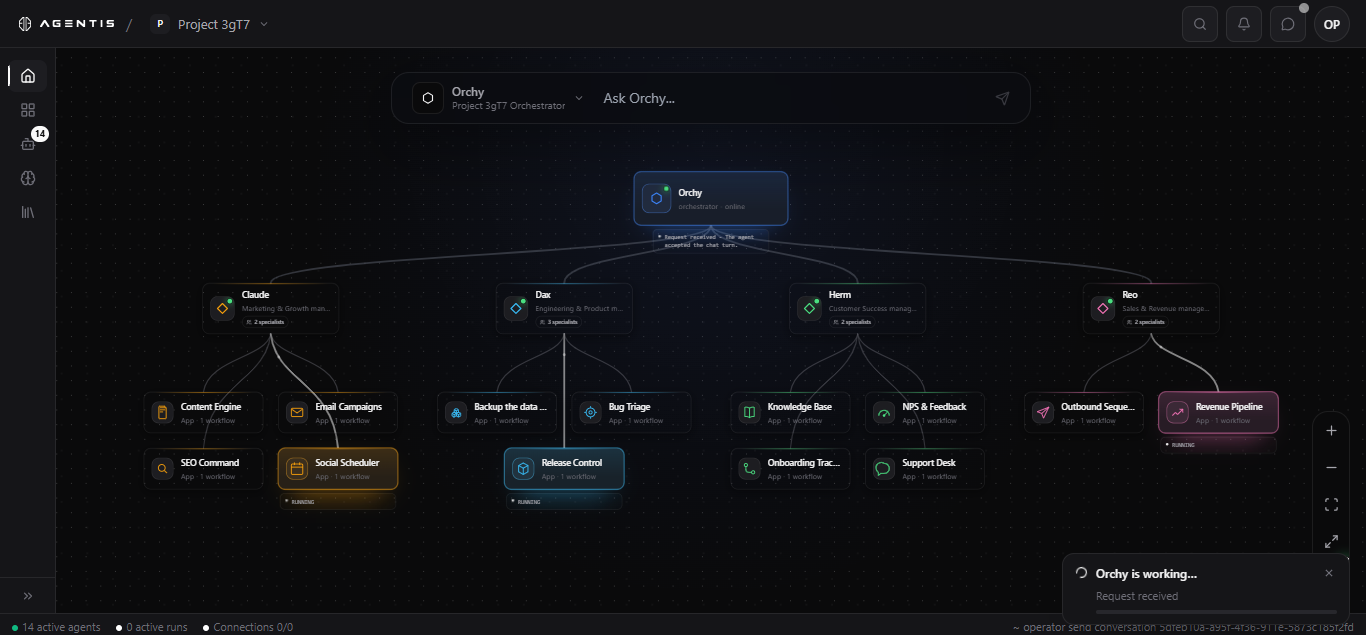
Agentis doesn't make you pick one. Import the agent you already run — no rewrite, no migration — and it keeps its memory, tools, and workflows even if you switch harnesses later.
| Harness | What it is | Runs as |
|---|---|---|
| Claude Code | Anthropic's Claude Code CLI | local CLI process |
| Codex | OpenAI's Codex CLI | local CLI process |
| Cursor | Cursor's agent CLI | local CLI process |
| Antigravity | Google's agy — the Gemini-CLI successor, also runs Claude and GPT-OSS models |
local CLI process |
| Hermes | Hermes agent runtime | local CLI process |
| OpenClaw | Bridged through OpenClaw's official ACP protocol | local ACP server |
| HTTP (custom / remote) | Any agent that speaks HTTP, with HMAC-signed callbacks | webhook |
| Local / OpenAI-compatible | Ollama, LM Studio, OpenRouter, and other OpenAI-compatible endpoints | local or remote API |
More harnesses land as adapters, not rewrites — and a harness of our own is next.
npm install -g @agentis-labs/cli
agentis up
Works on macOS, Linux, and Windows PowerShell with Node.js >= 20.10 installed. Agentis
boots at http://127.0.0.1:3737 in under 60 seconds, creates local secrets, initializes
SQLite, seeds the first operator user, and serves the dashboard from the same process.
No API keys required to see it boot. Connect your first harness — Claude Code, Codex, Cursor, or a local model — whenever you're ready.
On Windows, open a new PowerShell after the global install so npm's global command
shims are picked up on PATH.
Prefer Docker?
docker compose upThe CLI stays deliberately small — everything else runs through the API and dashboard.
| Command | What it does |
|---|---|
agentis up |
Boot Agentis on this machine (default when no command is given). |
agentis backup [--out <dir>] |
Snapshot the data dir — database, secrets, agent homes — into <dir>. |
agentis restore <dir> [--force] |
Restore a backup directory into the data dir. |
agentis create <dir> [--name <name>] |
Scaffold a code-authored Agentic App. |
agentis app validate|pack|test|install|export |
Validate, build, test, install, or export a .agentisapp package. |
agentis bootstrap --url <url> --api-key <key> --adapter <adapter> |
Commission an orchestrator, manager, or specialist agent through the API. |
agentis bootstrap generate-config --from <claude_code|codex> |
Generate an agentis-config.json scaffold from local harness context. |
agentis help |
Print the full command and flag reference. |
Run agentis help for the complete flag list on every command.
- Agent-run internal tools with durable data, live ops, approvals, and memory.
- Self-healing workflows that replay, diagnose, and improve from real outcomes.
- Specialist fleets that use Claude Code, Codex, Cursor, local models, or custom HTTP agents.
- Agentic apps that package workflows, interfaces, collections, and tests into
.agentisapp. - Channel-native agents that respond across Slack, Telegram, WhatsApp, email, MCP, and A2A.
One fabric for every runtime, not one more silo. Claude Code, Codex, Cursor, Antigravity (Gemini), Hermes, OpenClaw, OpenAI-compatible endpoints (Ollama, LM Studio, OpenRouter, and more), and local models all sit behind one Runtime Abstraction Layer. Route by capability, not vendor — and never rewrite your agents to switch one.
A permanent Brain, not a chat transcript. Durable memory lives locally with a bundled offline embedding model, formation gates, grounded knowledge, living skills, and cited answers — indexed through the Model Context Protocol so any harness you plug in reads and writes the same memory instead of starting cold.
Apps, not conversations that evaporate. Agents define typed data, generate UI surfaces, wire actions, and operate the product they created. No orchestration framework hands you back a wall of text and calls it done.
Self-healing orchestration, not brittle chains. The workflow engine runs typed graphs with 47 node kinds, durable snapshots, partial replay, checkpoints, subflows, objective verdicts, and repair paths that recover honestly instead of fabricating success — no prompt-chaining framework to debug by staring at stack traces of stack traces.
Reach people and systems. Slack, Telegram, WhatsApp, email, webhooks, MCP, A2A, and 90+ integration manifests all use the same connection registry, credential vault, and policy layer.
Agent-native by design. A typed agentis.* surface with 132 tools for building, running,
observing, repairing, governing, and shipping. Agents operate Agentis as code instead of
juggling brittle one-off tool calls.
Sovereign by default. SQLite, secrets, assets, agent homes, memories, and audit logs
live under AGENTIS_DATA_DIR unless you choose otherwise. Models are swappable. Harnesses
are swappable. Data stays yours.
The first run is self-contained:
- Generates an RSA-2048 JWT keypair and AES-256 credential-vault key in
.agentis/secrets.json. - Initializes embedded SQLite at
.agentis/agentis.dbwith WAL mode and foreign keys. - Seeds an
operatoruser, aPersonalworkspace, and aLocalambient. - Starts the HTTP API, WebSocket bridge, workflow engine, and bundled dashboard.
The seeded operator credential is printed once. Everything runtime lives under
AGENTIS_DATA_DIR by default, and the source tree stays clean.
Agentis is organized around seven core systems. The public technical guide lives at docs.useagentis.com. The source docs in this repository mirror the same architecture:
| System | What it gives you |
|---|---|
| Durable Spine & Six Primitives | One restart-durable entity model for Agent, Subject, Connection, Orchestration, Experiment, and Interface. |
| The Brain | Local semantic memory, grounding, knowledge bases, skills, citations, and learning from outcomes. |
| Agentic Applications | Typed data, agent-authored UI, actions, orchestration, subjects, and app packaging. |
| Self-Healing Orchestration | A 47-node workflow engine with replay, objectives, verdicts, and repair. |
| The Agent Fabric | Runtime-neutral routing across Claude Code, Codex, Cursor, Antigravity, Hermes, OpenClaw, local, and HTTP agents. |
| Sovereignty | Local-first data, encrypted secrets, portable backups, budgets, approvals, and audit. |
| Omni-Reach | Channels, MCP, A2A, webhooks, email, integrations, and outbound policy. |
| Agent-Native Core | The typed agentis.* tool surface agents use to build and operate the platform as code. |
apps/
  api/     Headless backend: Hono HTTP, socket.io realtime, workflow engine, Brain
  web/     React + Vite dashboard: canvas, brain, apps, chat, ledger, inbox
packages/
  core/          Shared types, schemas, errors, event names, RAL affordances
  db/            Drizzle schema for SQLite and Postgres dialects
  runtime/       Shared runtime primitives
  integrations/  Connector manifests and templated HTTP connectors
  app/           App package format
  app-client/    Client for embedding App surfaces
  sdk/           Programmatic build, validate, and test
  cli/           @agentis-labs/cli: up, bootstrap, backup, restore, app tooling
The API is the composition root. In production, the CLI serves the built web dashboard from the same Node process that owns the API, WebSocket bridge, workflow engine, local database, memory, apps, and agent runtime adapters.
All configuration is via environment variables, and every common value has a local default.
See .env.example for the complete set.
| Variable | Default | Purpose |
|---|---|---|
AGENTIS_DATA_DIR |
./.agentis |
SQLite DB, secrets, agent homes, backups. |
AGENTIS_ARCHIVE_DIR |
$AGENTIS_DATA_DIR/archives |
Lossless gzip archives for aged run state and telemetry. |
AGENTIS_STORAGE_FULL_RUN_DAYS |
7 |
Days to retain full terminal run state in the hot database. |
AGENTIS_STORAGE_LEDGER_DAYS |
30 |
Days to retain terminal-run ledger events hot before archiving. |
AGENTIS_STORAGE_OBSERVABILITY_DAYS |
14 |
Days to retain observability events hot before archiving. |
AGENTIS_STORAGE_MAX_HOT_DB_MB |
2048 |
Hot SQLite budget; pressure mode shortens hot retention without deleting archives. |
AGENTIS_STORAGE_MIN_FREE_MB |
2048 |
Free-space reserve that activates pressure mode. |
AGENTIS_ASSETS_DIR |
{DATA_DIR}/assets |
Content-addressed blob store, deduped by SHA-256. |
AGENTIS_HTTP_PORT |
3737 |
API and dashboard port. |
AGENTIS_HTTP_HOST |
127.0.0.1 |
Bind host. |
AGENTIS_EXTENSION_REQUIRE_ISOLATE |
unset | Fail closed instead of using node:vm for untrusted extension code. |
AGENTIS_EXTENSION_DOCKER |
unset | Enable the Docker extension sandbox. |
AGENTIS_ORCHESTRATOR_BASE_URL / _API_KEY / _MODEL |
unset | Optional OpenAI-compatible model endpoint for the orchestrator. |
pnpm install
pnpm -r typecheck
pnpm -r test
pnpm doctor
pnpm dev:full
Requires Node.js >= 20.10 and pnpm 9.12.
Useful contributor commands:
pnpm lint
pnpm build
pnpm test:e2e
pnpm db:generate
pnpm db:migrate- Every authenticated request re-checks workspace and user ownership.
- Secrets are stored in an AES-256-GCM credential vault and never returned decrypted.
- Passwords use bcrypt; JWTs use RS256 with access/refresh kind separation.
- Workflow configs are validated through discriminated unions and safe parsers, not
eval. - Agent and extension HTTP is IP-pinned and blocks private ranges by default.
- Extension code defaults to
node:vm; useisolated-vmor Docker for untrusted code.
Report vulnerabilities privately per SECURITY.md.
- Docs: docs.useagentis.com for the full technical guide.
- Issues: GitHub Issues for bugs and feature requests.
- Discussions: GitHub Discussions is the current war room for early adopters — architecture questions, build logs, and what you're shipping with your Brain.
Issues and PRs are welcome. Start with CONTRIBUTING.md, and keep security reports private per SECURITY.md.
Before opening a PR:
pnpm -r typecheck && pnpm -r test && pnpm lintApache-2.0. See LICENSE.