
One set of rules every AI coding agent follows, one command that says the work is done, and a gate that turns AI slop red.


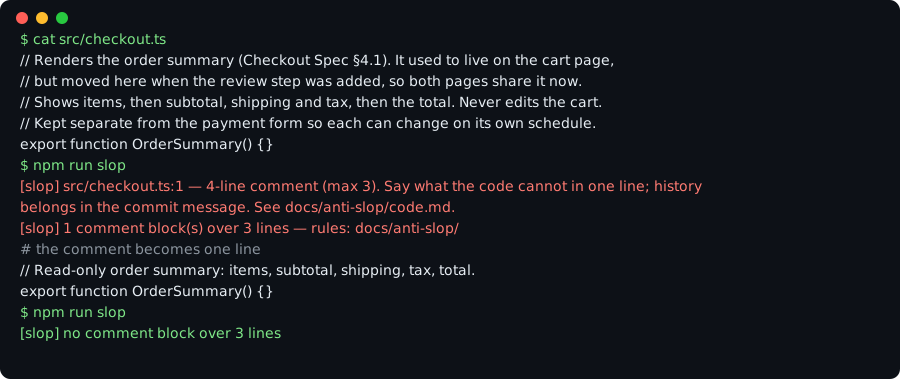
A project starter that makes a new repo ready for AI coding agents — structure and contracts only, no stack lock-in. Copy it, fill the placeholders, and every coding session starts with the right rules, the right docs, a working issue tracker and one command that means "is this green?" — whichever AI tool and whichever framework you use. You type only the task.
1. Every AI tool looks for a different file. Rules written for one agent are invisible to the
next. Here AGENTS.md is canonical, and npm run agents:sync generates a pointer for every other
front door — so opening this repo in Cursor, Copilot, Gemini CLI, Windsurf, Cline, Junie or Aider
loads the same contract instead of nothing.
2. "Run the tests" means something different in every framework. Here it is always
npm run gate. What that expands to comes from a 70-entry framework registry (55 frameworks,
15 language bases) that detects your stack and writes the real commands into package.json.
3. Agents write slop that nobody asked for. Narrative comments, filler copy, generic screens.
Here the rules live in docs/anti-slop/, and the ones a machine can check run first in every
npm run gate: a comment over three lines fails it, in any of 76 languages, and so does text in
DESIGN.md that misses WCAG AA contrast.
| Piece | What it does |
|---|---|
AGENTS.md |
Canonical rules, read by every agent. Session working rules (docs-by-route, read-before-write, finish-100%, verify-before-claiming, no dead code, one-question rule, worktree isolation, completion report) + placeholders to fill per project. |
| Per-tool pointers | CLAUDE.md (@AGENTS.md import + Claude-only extras) plus generated stubs for Copilot · Gemini CLI · Cursor · Windsurf · Cline/Roo · Junie · Aider. Each restates the non-negotiables inline, so an agent that ignores file references is still bound by them. Coexists with other tools that write to the same files: a region fenced off between <!-- name:start --> / <!-- name:end --> or <!-- BEGIN name --> / <!-- END name --> markers (bd writes one, and every rules installer has its own) is carried across instead of overwritten — this repo owns the generated part of those files, not the whole file. |
| Framework registry | scripts/stacks.json — detection markers, gate commands, .gitignore lines, core-layer rule and conventions per framework. Adding one is a JSON row, no code change. Schema-validated by the test suite. |
npm run gate |
One command in every language: lint → typecheck → test → build, stopping at the first failure. Polyglot repos (Tauri, a Next.js + FastAPI monorepo) run both sides. The first stack:apply in a renamed project swaps agentready's own gates for your framework's; after that they are yours. |
docs/STACK.md |
Generated per project: which framework was detected, where heavy logic belongs, the exact gate commands, framework conventions. The brief a fresh agent reads instead of guessing. |
docs/ skeletons |
PRD · ARCHITECTURE · FEATURES · TASKS · ROADMAP · VERSIONING — thin frames, not content. |
| Archive contract | docs/archive/STATUS_ARCHIVE.md + TASKS_ARCHIVE.md: when work merges, its full story moves here and AGENTS.md keeps ≤ 1 bullet per domain — the always-loaded context never bloats. |
| Read guard | scripts/read-guard.mjs, a Claude Code hook that denies reading a whole file over 400 lines without an offset/limit window, and says how to read the part you need instead. Whole files read to find one function are the largest single entries in a long session's context, and nothing takes them back out. |
| Anti-slop | Rules for code, UI, copy and reports in docs/anti-slop/, enforced wherever a machine can check them: npm run gate runs a comment check first, in every language the registry knows, and in Claude Code slop-guard names a long comment right after the edit. |
DESIGN.md |
The visual identity agents build UI from, in the open DESIGN.md format: tokens (colours, type, spacing, radii, components) in the front matter, how to use them in eight fixed sections. It ships as a frame with every token group marked omitted, so the look is decided there before the first screen. npm run gate checks its format and the WCAG AA contrast of every component's text, unrounded, with the 3:1 limit only for text that is actually large; npm run design:lint runs the format's own linter. |
| Beads issue tracker | Optional bd wiring with rules reconciled for this workflow: bd = cross-session issues, docs/TASKS.md = roadmap checklist, no auto-push. Silent when bd is not installed, and refuses to initialise until you rename the project — bd commits an identity, which must not ship from agentready. |
| Auto-versioning | A conventional-commit hook bumps semver in package.json and syncs every other manifest that exists — inside the same commit. |
| No agent attribution | Three layers, because one bad commit is permanent — it puts a bot in your GitHub contributor list, removable only by rewriting published history. .claude/settings.json stops Claude Code adding Co-Authored-By, a "Generated with" line or a session link, and arms the hooks at session start; .githooks/commit-msg strips them whatever tool wrote them — Cursor, Copilot, or one that does not exist yet; and .github/workflows/attribution.yml fails the build if any commit carries them anyway, which is the layer that covers a fresh clone where no hook is installed yet. The rule is one author per commit: every Co-Authored-By line goes, not only an agent's, because separating the two was tried by name (which deleted a real person whose address contained "amp") and by bot address (a list that must grow with every new agent, where one miss is permanent). Credit collaborators in the commit body. If one lands anyway, rewriting history removes the commit but not GitHub's cached contributor list; renaming the default branch away and back makes GitHub rebuild it. |
scripts/setup.mjs |
One-shot, idempotent, ordered bootstrap (order matters — see below). |
npm run stack:detect reads the markers in your repo; npm run stack:apply writes the answer into
package.json → tooling.gates, the .gitignore managed block and docs/STACK.md.
| Group | Entries |
|---|---|
| Desktop | Electron · Tauri · Wails · .NET MAUI · Avalonia |
| JS frontend | Next.js · Nuxt · React+Vite · Angular · Vue · SvelteKit · Astro · Remix/RR7 · SolidStart |
| JS backend | Express · NestJS · Fastify · Hono · AdonisJS · Elysia |
| Mobile | Expo · React Native (bare) · Flutter · Ionic/Capacitor · Android |
| PHP | Laravel · Symfony · CodeIgniter 4 · Slim · WordPress |
| Python | Django · FastAPI · Flask · Streamlit |
| Go | Gin · Echo · Fiber · chi |
| Rust | Axum · Actix · Rocket · Leptos |
| JVM / .NET | Spring Boot · Ktor · Quarkus · ASP.NET Core · Blazor |
| Other | Rails · Sinatra · Phoenix · Unity · Godot · Terraform · Helm · Docker Compose |
| Language bases | Node · Deno · Bun · Python · PHP · Go · Rust · Maven · Gradle · .NET · Ruby · Elixir · Dart · Swift · C/C++ |
Frameworks inherit their language base through extends, so Laravel gets PHP's rules plus its own,
and Tauri composes Rust and Node.
On honesty: all 70 entries are verified — most of them against a project the framework's own
creator produced, on GitHub's runners (.github/workflows/verify-stacks.yml). Anything that is
not gets marked "verified": false, and its generated docs/STACK.md carries a visible "verify
these commands before trusting them" banner. A wrong command an agent believes is worse than one
it is told to check. That count is asserted by the test suite, so this paragraph cannot quietly
go stale.
Adding your framework — one entry in scripts/stacks.json, then npm run stack:validate:
If your framework is built on another one, give it more signals than that one has. Ties break
alphabetically, and this has bitten three times: Wails vendors labstack/echo and was detected as
Echo; an Ionic Angular app was detected as Angular; the official Leptos starter was detected as
Axum. Each was fixed by adding the marker that is definitive for the specific framework —
wails.json, @capacitor/core, [package.metadata.leptos]. The underlying framework then stays
on as a secondary, so its real gate commands still run.
package.json is the version source of truth (it exists in every copy as the tooling manifest,
whatever the app language). scripts/version.mjs propagates it to every manifest present:
| Stack | Synced target |
|---|---|
| JS/TS · Deno · Expo | package.json (source of truth) · deno.json · app.json (only when it is an Expo manifest) |
| Rust · Tauri | Cargo.toml + Cargo.lock — at the repo root and/or src-tauri/ · src-tauri/tauri.conf.json |
| PHP | composer.json (only when it declares "version" — Packagist omits it, and that is respected) |
| Python | pyproject.toml ([project] or [tool.poetry]; skipped when dynamic) |
| Dart / Flutter | pubspec.yaml (the +build number is preserved, never auto-incremented) |
| Java / Kotlin | pom.xml (the project's own <version>, never <parent>'s or a dependency's) · gradle.properties · versionName in build.gradle(.kts) |
| .NET | *.csproj, src/*/*.csproj, Directory.Build.props (<Version> / <VersionPrefix>) |
| Elixir · Ruby · Helm | mix.exs · *.gemspec and lib/**/version.rb · Chart.yaml (version and appVersion) |
| WordPress | the Version: header of a plugin/theme file that actually declares one |
| Go / anything else | a root VERSION file (go:embed / -ldflags) |
Deliberately not touched, because they are release counters rather than semver: Android
versionCode, the Flutter build number, Xcode MARKETING_VERSION, Expo runtimeVersion.
# 1. a new project with a history of its own, named after its directory (nothing links back here)
npx @ahnafudin/agentready init my-app
cd my-app
# 2. bootstrap (safe to re-run any time)
npm install # activates the version hook via postinstall
npm run setup # hooks → framework detection → agent docs → beads → dolt remote
# 3. check what it detected, then fill the <!-- TODO:fill --> sections
cat docs/STACK.md # framework, core layer, gate commands
npm run gate # should already run something sensibleThen open any AI coding tool and type your task — the rules ride along automatically.
Without npm, clone it (git clone --depth 1 https://github.com/ahnafudin/agentready.git my-app),
replace its .git with a fresh git init, and set name in package.json before step 2: while it
is my-project, the scripts treat the copy as agentready itself.
Into a repo you already have — npx @ahnafudin/agentready add copies only what is missing.
Every file you already have is kept and listed, and npm scripts are added without replacing any.
Only the hooks, in Claude Code — the read guard, the slop guard and /agentready:anti-slop,
in any project, without copying anything:
/plugin marketplace add ahnafudin/agentready
/plugin install agentready@agentready
Only the comment check, in any repository's CI — one annotation per long comment on the pull
request. paths is optional; without it every tracked file is checked:
- uses: actions/checkout@v7
- uses: ahnafudin/agentready/slop@main # pin a release tag for a stable check| Command | What it does |
|---|---|
npm run setup |
One-shot bootstrap. Idempotent; safe to re-run on any machine. |
npm run gate |
The one command that means "is this green?" — slop → design → lint → typecheck → test → build, stopping at the first failure. |
npm run slop |
The comment check alone (tooling.slop in package.json sets the limit and ignored paths). |
npm run design |
The DESIGN.md check alone: format, token references and text contrast. |
npm run design:lint |
The DESIGN.md format's official linter, fetched with npx (not part of the gate). |
npm run gate test |
A single stage. |
npm run gate:list |
What gate would run, without running it. |
npm run stack:detect |
Which framework matched, its bases, and the full ranking. |
npm run stack:list |
All 70 registry entries. |
npm run stack:apply |
Refresh docs/STACK.md, tooling.gates and the .gitignore block. |
npm run stack:reapply |
Same, but overwrite hand-tuned gates from the registry. |
npm run stack:validate |
Check scripts/stacks.json against its schema. |
npm run agents:sync |
Regenerate the per-tool pointer files from AGENTS.md. |
npm run agents:check |
Are they stale? (part of gate) |
npm run version:get · :patch · :minor · :major · :sync |
Manual version control. |
Why
gate:listandstack:reapplyare separate scripts:npm run gate --listdoes NOT work — npm swallows a leading flag instead of forwarding it, so you would get a full gate run instead of a listing. A bare argument (npm run gate test) does pass through. Rather than expect every agent to remembernpm run gate -- --list, the flag-taking forms get their own script — and a test fails the build if any doc reintroduces the broken form.
scripts/setup.mjs runs git hooks → personalise → stack detection → agent docs → beads init →
Claude hooks → dolt remote, because:
bd initmovescore.hooksPathto.beads/hooksand chains whatever hook is already installed — install the version hook first or it gets orphaned.- Personalising comes before stack detection: it keys off
tooling.pristine, which the detection step then clears. bd initauto-commits everything staged — the script refuses to run it on a dirty index, and every step before it writes only unstaged changes, so nothing can be swept in.- bd is optional: when it is missing, steps 5–7 are skipped and the rest still completes.
- The Dolt sync remote lives in the local DB, not in git — it must be added per machine.
The first npm run setup in a renamed project personalises it, once:
| Scaffolding | Becomes |
|---|---|
version 0.2.x (agentready's release history) |
0.1.0 |
| this README | a README about your project; this one is kept as docs/TOOLING.md |
tooling.gates (commands that maintain agentready) |
your framework's gates, from the registry |
the test npm script (the tooling's own suite) |
free for your project; the suite stays at test:tooling |
| no beads workspace | initialised with YOUR issue prefix and remote |
agentready's MIT LICENSE |
kept as docs/TOOLING-LICENSE beside the tooling it covers; the root is yours to license |
CONTRIBUTING.md (how to contribute to agentready) |
removed |
what serves agentready's own repository: code of conduct, security policy, issue and PR templates, README assets, the verify-stacks and release workflows |
removed |
All of it is keyed off tooling.pristine and happens exactly once. Nothing you have written is
ever replaced. scripts/tests/derived-project.test.mjs builds a copy, renames it, bootstraps it and
runs this whole suite inside it — every one of those rows is a bug agentready shipped until a
real generated app exposed it.
See SETUP.md → "Second machine" for the exact checklist (what git carries for you, what is
per-machine, and how to sync beads issue data with bd dolt push / bd dolt pull).
AGENTS.md CANONICAL rules — edit here, then `npm run agents:sync`
CLAUDE.md @AGENTS.md import + Claude-Code-only extras
DESIGN.md visual identity: design tokens + how to use them (open DESIGN.md format)
GEMINI.md CONVENTIONS.md .cursor/ .windsurf/ .clinerules/ .junie/ .github/copilot-instructions.md
generated pointers — do not hand-edit
.aider.conf.yml makes Aider read CONVENTIONS.md, which it loads only when told to
SETUP.md fill-in checklist · second-machine checklist
CONTRIBUTING.md LICENSE how to contribute · MIT (both leave a project made from agentready)
CODE_OF_CONDUCT.md SECURITY.md community rules · private vulnerability reports (agentready only)
docs/
STACK.md GENERATED per project: framework, core layer, gate commands
VERIFYING.md how an entry earns `verified`, and what that has caught
TOOLING.md this README, once a project has been made from agentready
TOOLING-LICENSE agentready's licence, likewise
anti-slop/ rules against AI slop: code · ui · copy · human
PRD.md ARCHITECTURE.md FEATURES.md TASKS.md ROADMAP.md VERSIONING.md
archive/ STATUS_ARCHIVE.md · TASKS_ARCHIVE.md (the anti-bloat contract)
scripts/
stacks.json the framework registry (DATA — add frameworks here)
stacks.schema.json its schema, enforced by the test suite
comments.json comment syntax per language (DATA — add languages here), with sources
comments.schema.json its schema, enforced before every comment check
stacks.mjs detect → package.json / .gitignore / docs/STACK.md
gate.mjs `npm run gate`
version.mjs semver source of truth + every manifest it syncs
sync-agents.mjs AGENTS.md → per-tool pointer files
personalize.mjs personalise a fresh copy (version → 0.1.0, project README, licence)
verify-stack.mjs detect + run the gates of a scaffolded project
check-attribution.mjs the commit-msg rule, applied to history in CI
setup.mjs install-hooks.mjs bd-prime.mjs
read-guard.mjs denies an unbounded Read of a long file (Claude Code hook)
slop-check.mjs `npm run slop`: the comment check the gate runs first
design-check.mjs `npm run design`: DESIGN.md format and text contrast, the gate's second check
slop-guard.mjs the same check right after each edit (Claude Code hook)
lib/ shared utils (git, globs, managed blocks, JSON-Schema subset)
tests/ `node --test` via run.mjs, zero dependencies
.claude/settings.json Claude Code hooks + no-attribution settings
.githooks/
post-commit conventional-commit auto-version
commit-msg strips AI-agent attribution, whichever tool wrote it
.github/workflows/
attribution.yml fails the build if any commit carries AI-agent attribution
gate.yml the same `npm run gate`, on Linux, Windows and macOS
verify-stacks.yml scaffolds real projects and verifies registry entries (agentready only)
release.yml tags and releases every version main reaches, then the npm CLI (agentready only)
slop-action.yml runs the slop Action against this repository (agentready only)
.github/ISSUE_TEMPLATE/ pull_request_template.md assets/ (agentready only)
.claude-plugin/ this repository as a Claude Code plugin and marketplace (agentready only)
slop/ the comment check as a GitHub Action (agentready only)
packages/agentready/ the npm CLI: `init` and `add` (agentready only)
Fork, branch, npm run gate, pull request. The full guide — and the invariants the test suite
protects — is CONTRIBUTING.md.
MIT © 2026 ahnafudin. A project
made from agentready keeps that notice in docs/TOOLING-LICENSE, beside the tooling it
covers, and chooses its own licence.
{ "id": "my-framework", "tier": "framework", "extends": "node", "verified": true,
  "detect": { "any": [{ "file": "myfw.config.*" }, { "dep": "my-framework" }] },
  "gates": { "test": "myfw test", "build": "myfw build" },
  "ignore": [".myfw/"],
  "coreLayer": "where heavy logic belongs in this framework",
  "conventions": ["the rule an agent would otherwise get wrong"] }