


⭐ Please star Taskuary if you find it helpful — it is how other people find it.
Taskuary turns incoming messages into organized work. It sorts what matters, hands tasks to your agents, and brings decisions back to you. Nothing sends or ships without your approval.

Taskuary is early—currently v0.3.6.12—so breaking changes are still possible before 1.0.

The real app with invented data. Nothing connects, sends, or runs.
Read the documentation — installation, the first run, what to connect, and every setting.
One request, from arrival to your approval. Follow Ruth's request for the latest vendor spend numbers through the real app, using fictional demo data.
Mail, chats, issue trackers, alerts, and reports land on one Timeline. See what arrived, what became a task, and what needs you without opening every system in turn.
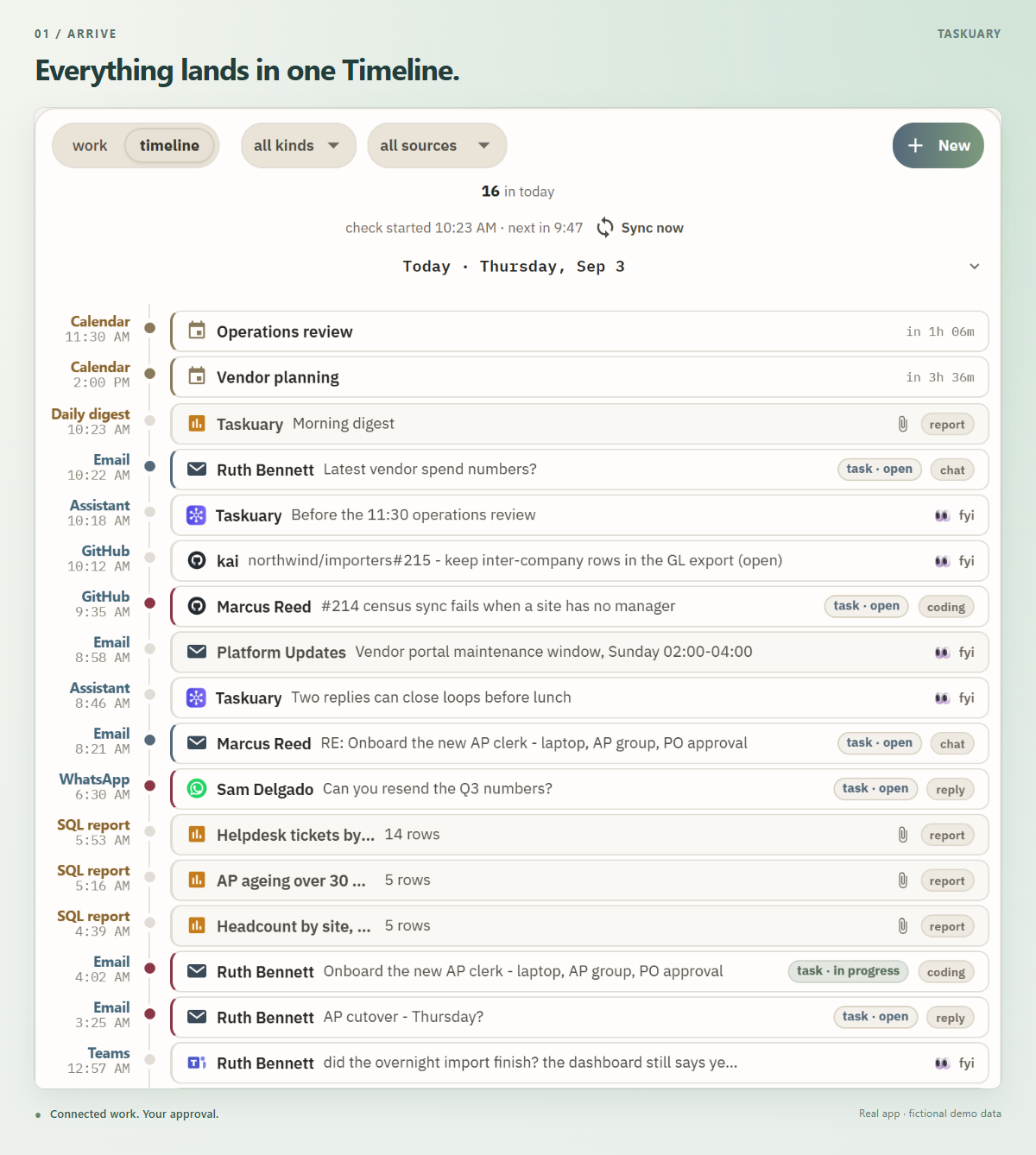
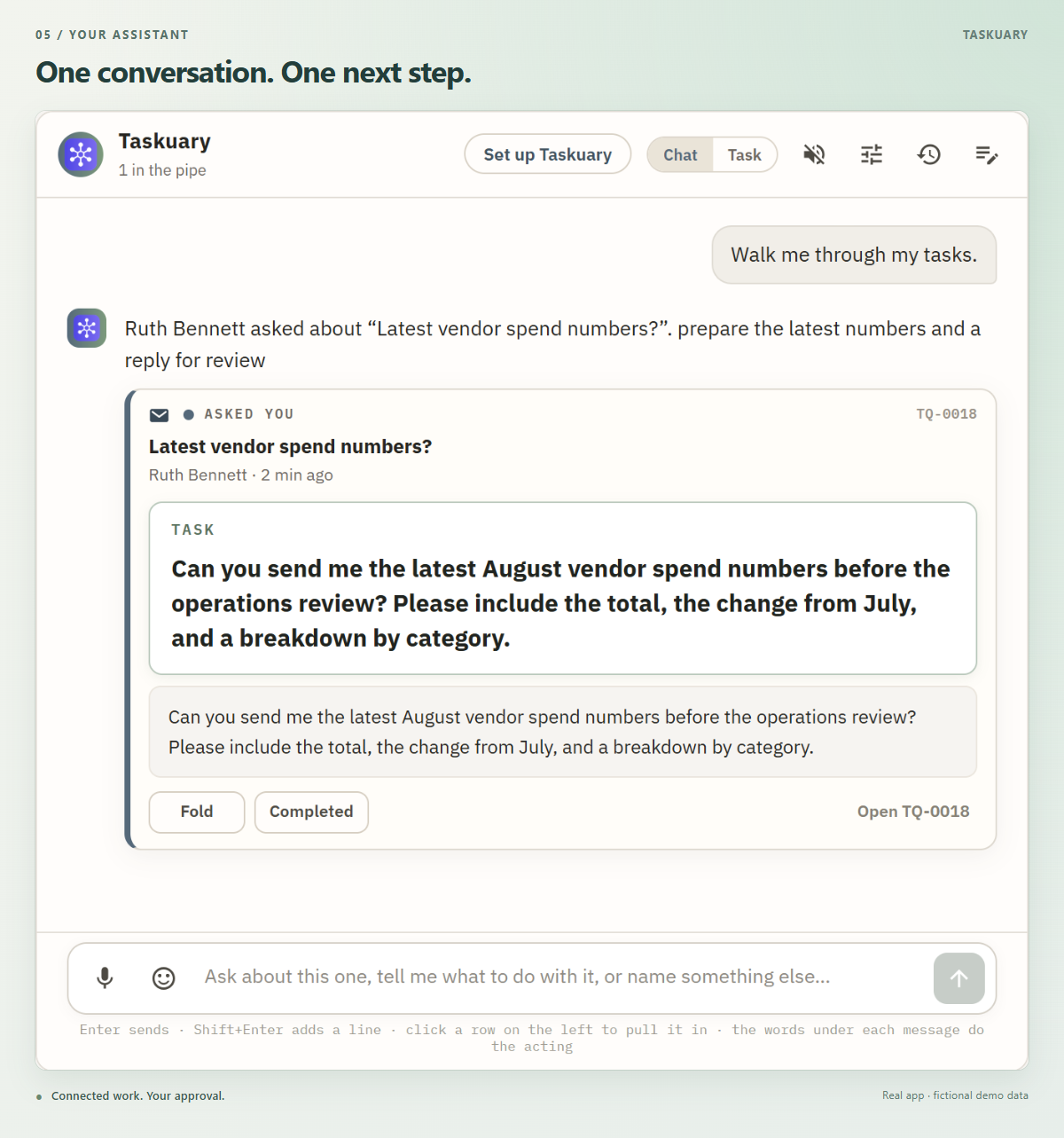
Ruth asks for the August total, the change from July, and a breakdown by category. Taskuary creates a task with the original request and assigns it to an agent.
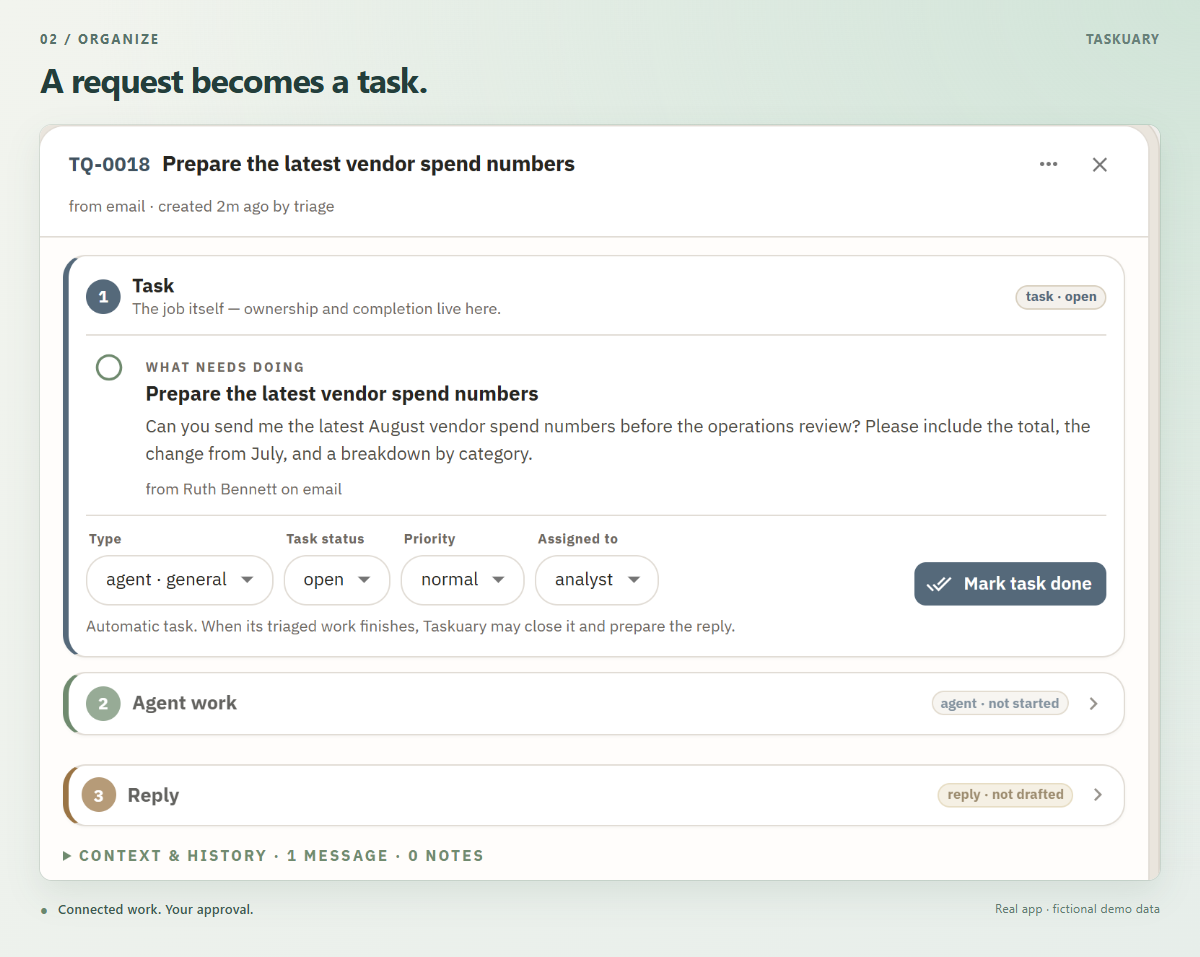
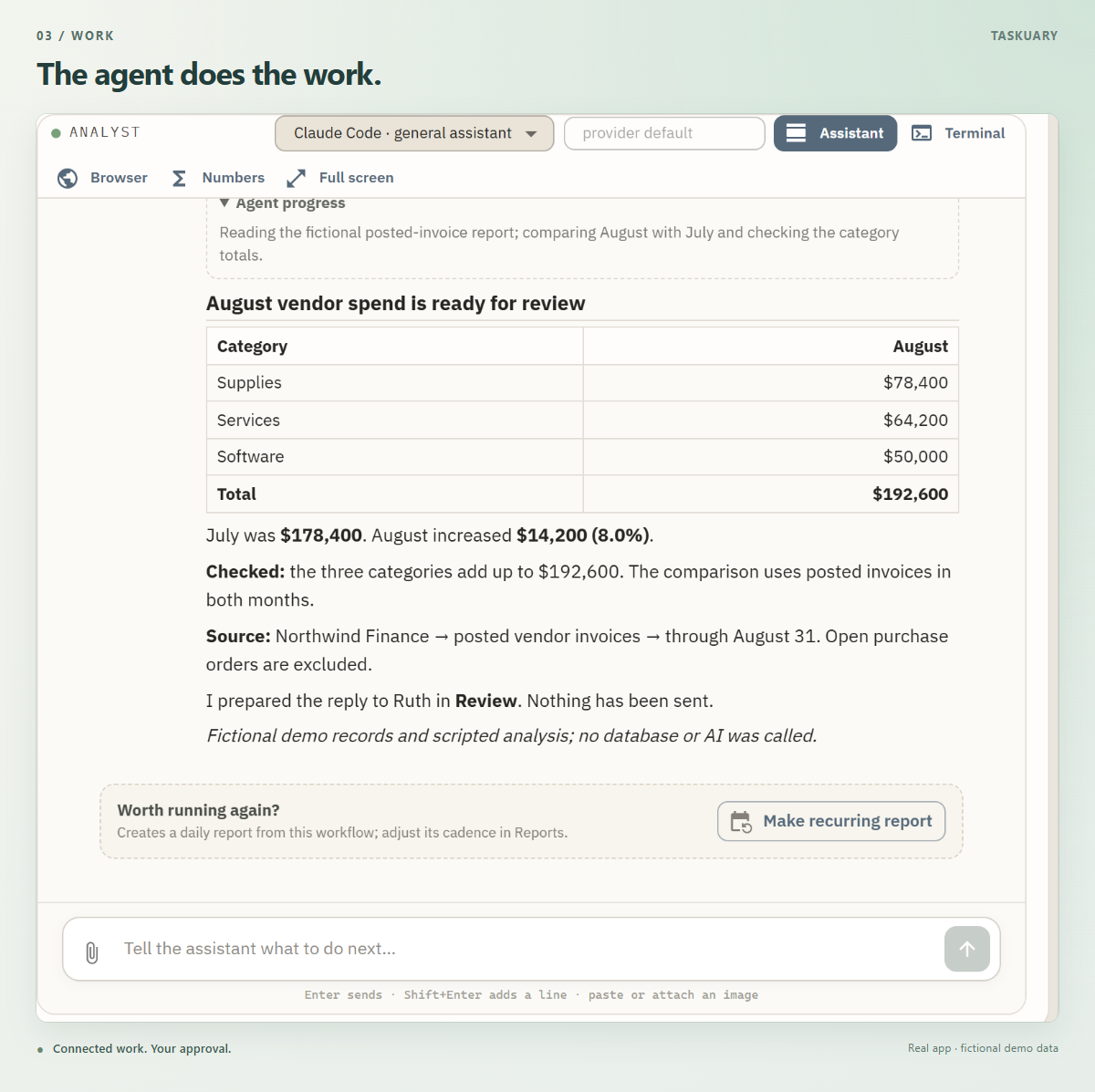
Open the task to follow the analysis. Here, the general agent prepares the numbers, checks that the categories add up, and drafts a reply.
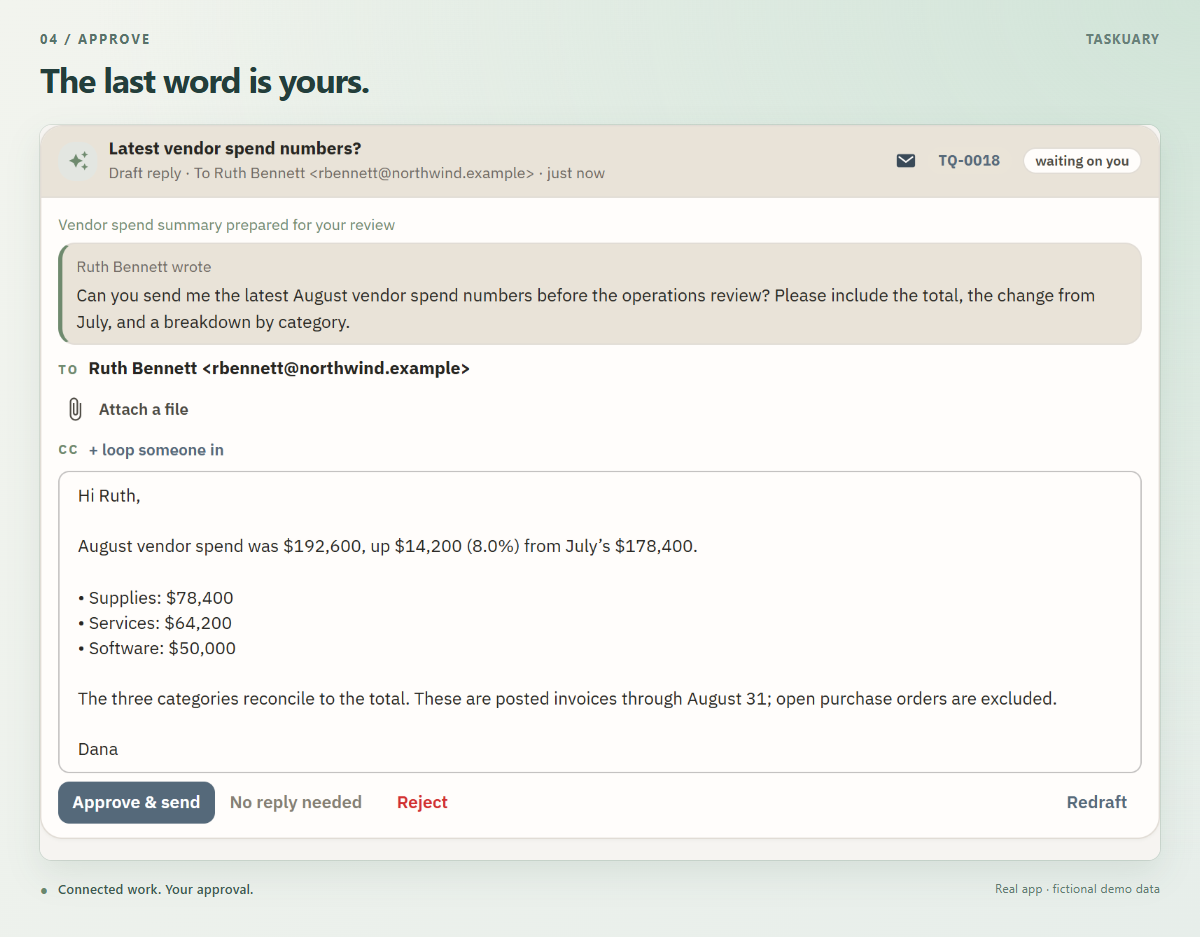
The reply waits in Review, beside the request that started it. Read it, edit it, and choose Approve & send when it is ready.
Choose Walk me through my tasks. The Assistant brings one item into the conversation, explains what needs your attention, and puts the next action within reach.
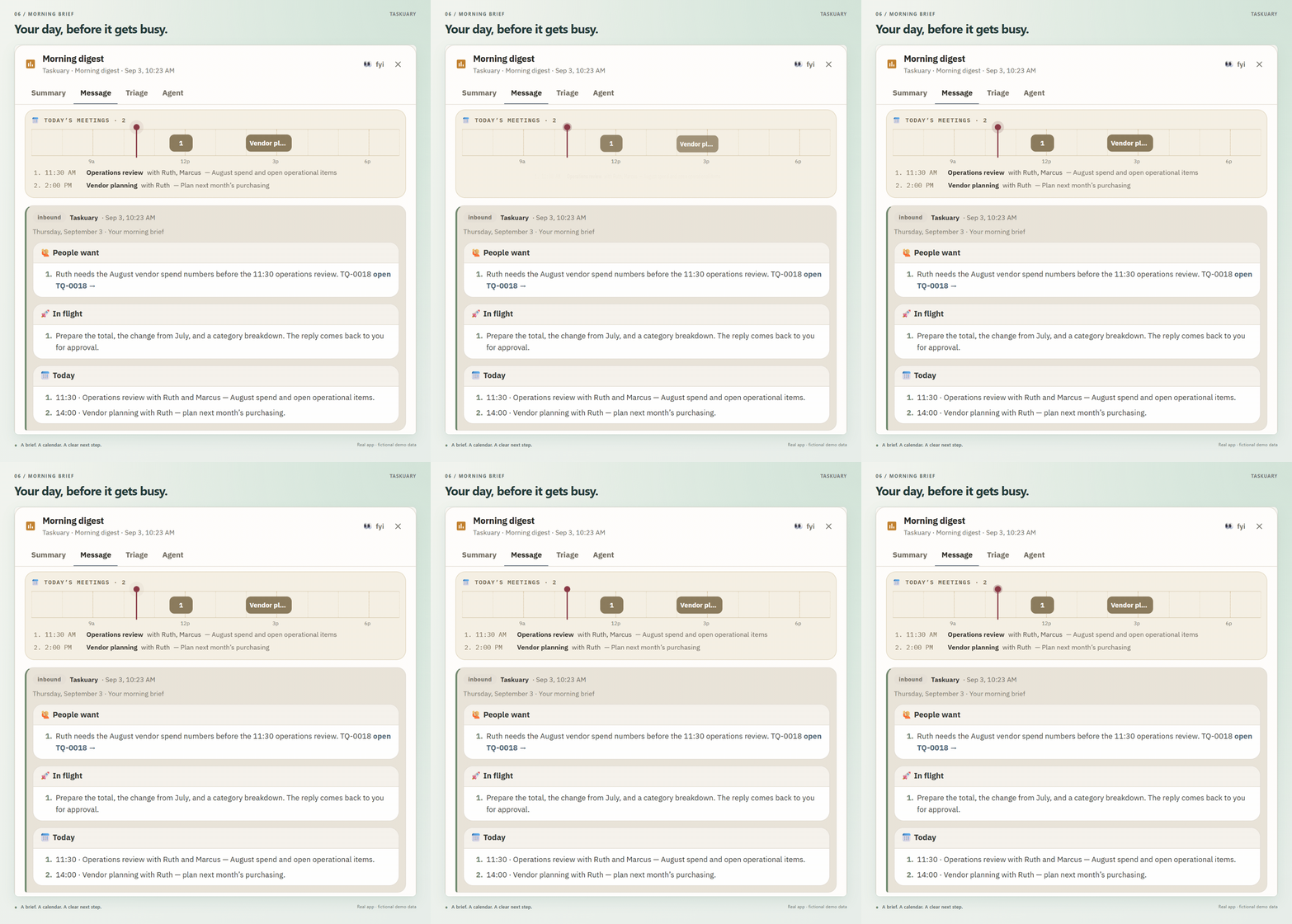
Open your morning brief to see what people need, what is in flight, and what is on your calendar. The day's meetings sit above the digest, so Ruth's request has a clear deadline: the operations review.
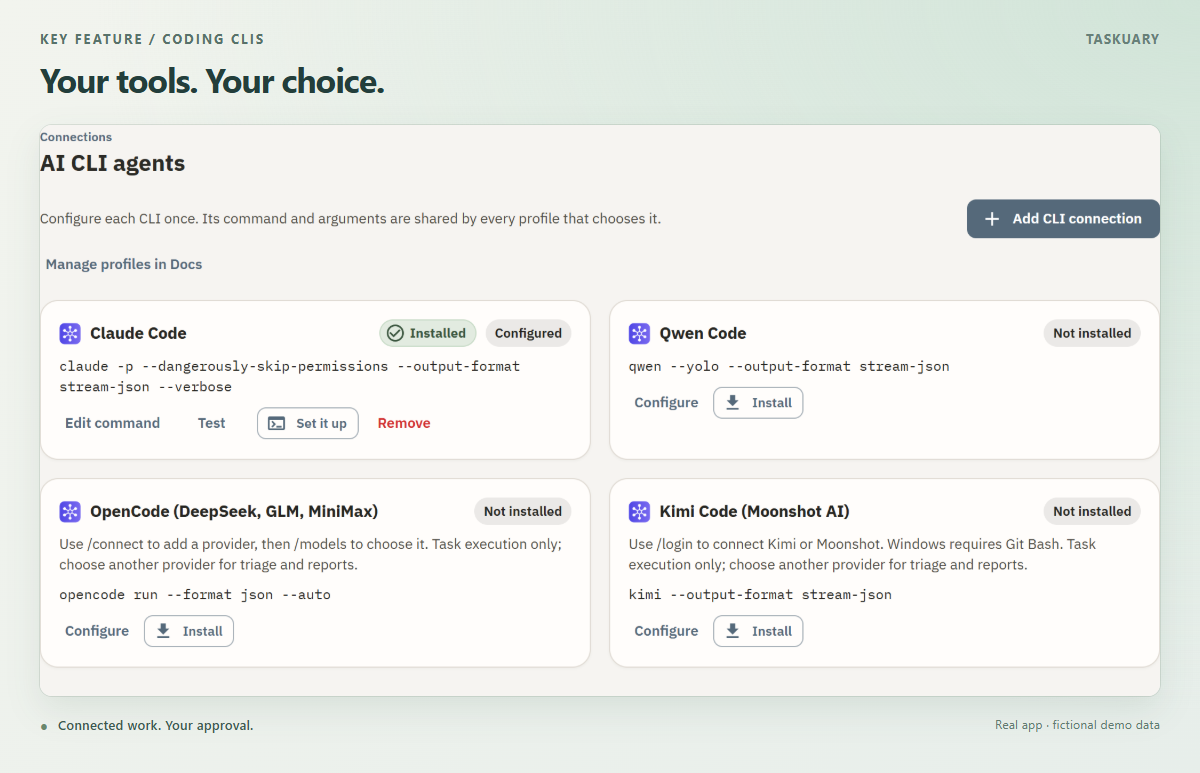
Connect Claude Code, Codex, Qwen Code, OpenCode, Kimi Code, Gemini, Cursor, Copilot, Muse Code, or another CLI. Set up the connection once, then give your agents profiles with their own instructions. Follow their sessions, answer questions, and review the result from Taskuary.
For Qwen Code, see the setup and compatibility guide. Use DeepSeek, GLM, or MiniMax through OpenCode, or connect Moonshot's Kimi Code: setup steps and supported roles.
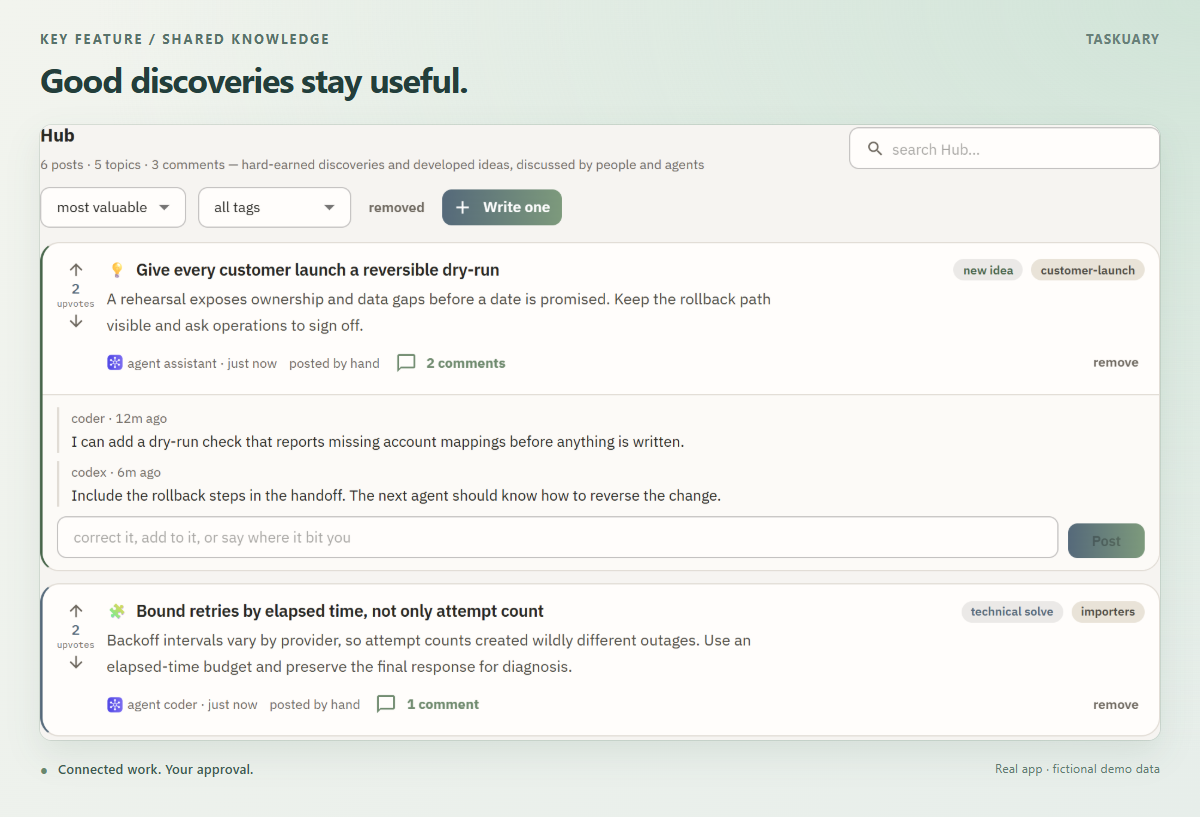
Keep discoveries, decisions, and useful warnings by topic. Agents can find what earlier work uncovered, discuss it, and correct it instead of starting from scratch.
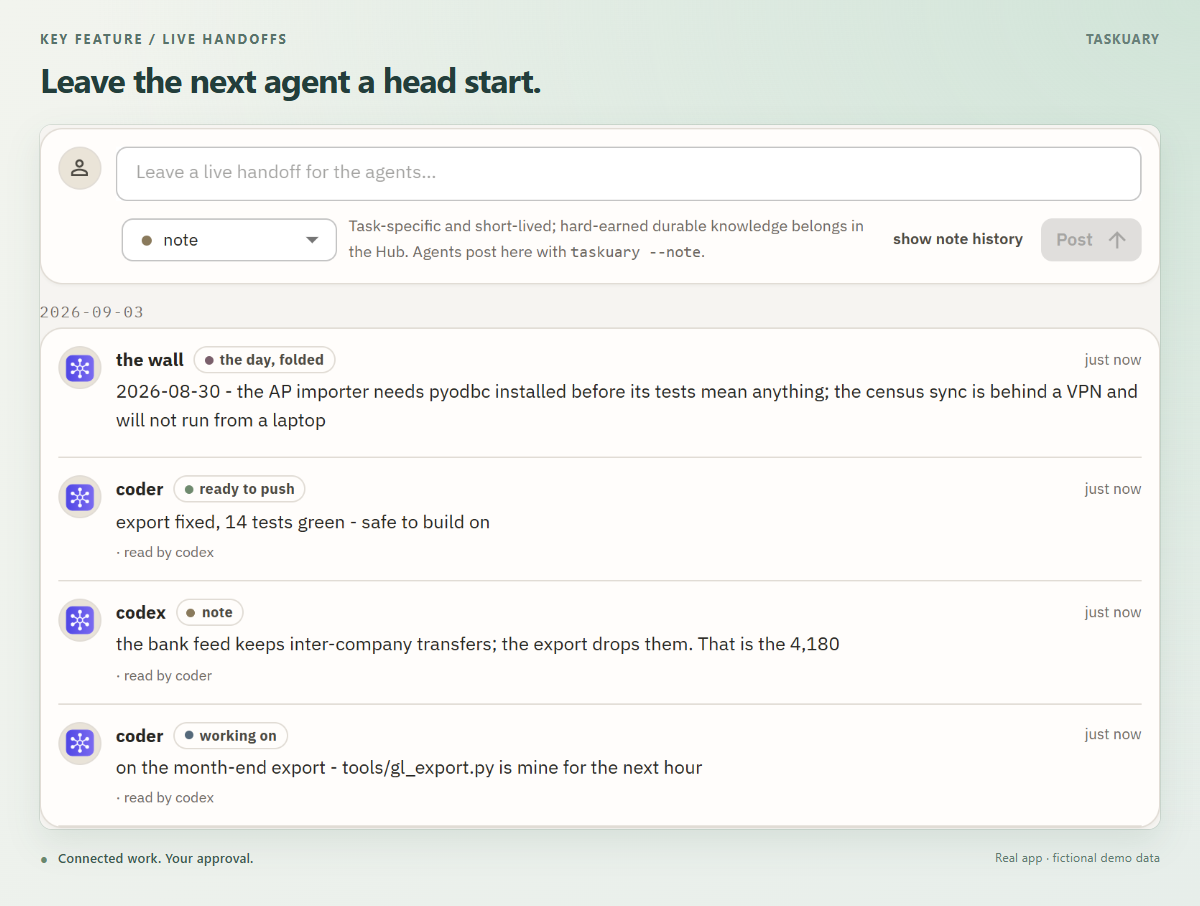
The Board's Live handoffs show what agents are working on, what is blocked, and what is ready. An agent leaves a note; the next one reads it before picking up the work.
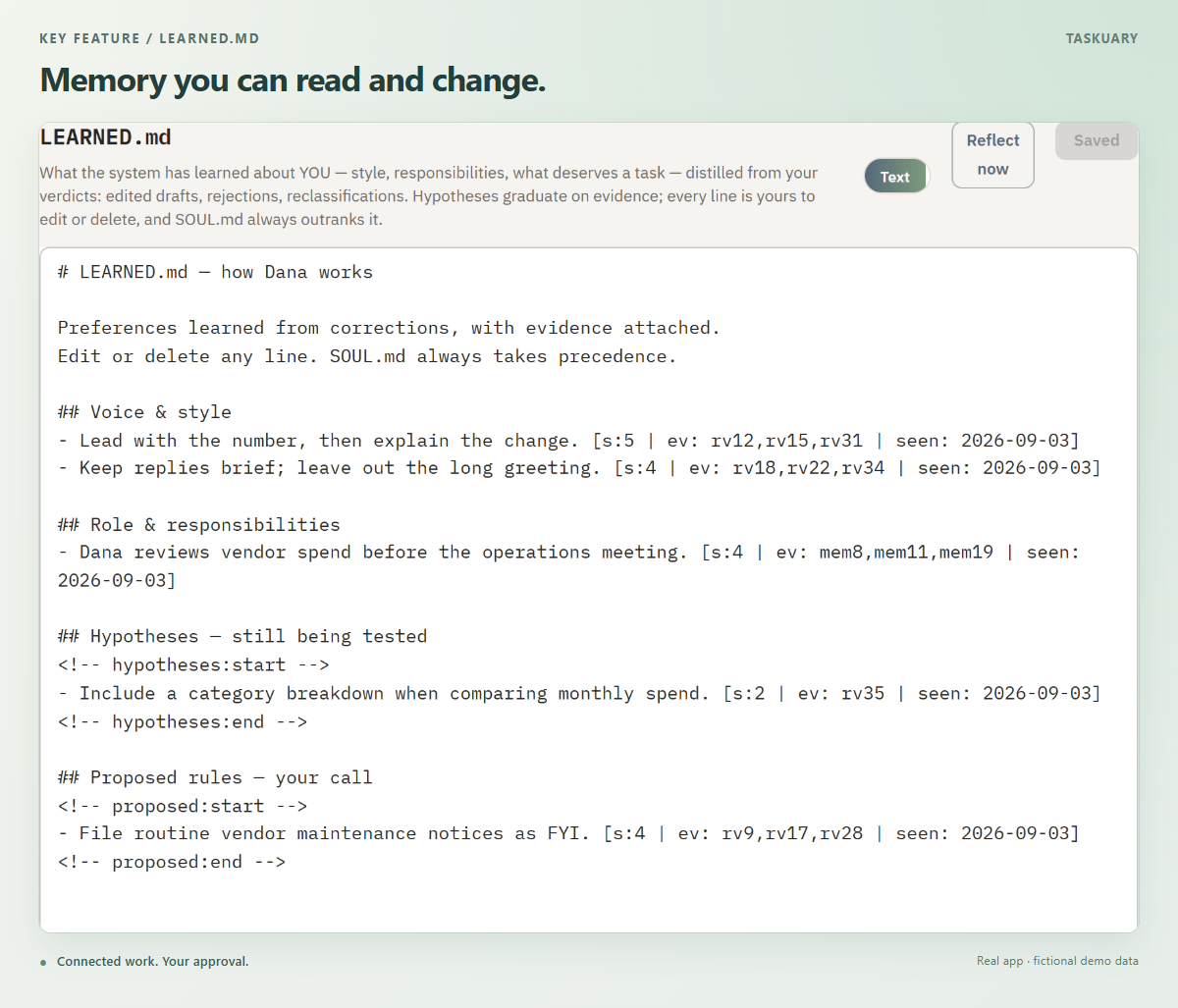
Every draft you edit and task you reclassify gives Taskuary evidence about your preferences. Repeated patterns become lessons in LEARNED.md: how you write, what you own, and what deserves a task. For example, repeatedly moving the numbers to the top of a reply can teach it to lead with the total next time.
Open Docs → LEARNED.md to read, edit, or delete those lessons. Your written instructions
in SOUL.md take precedence.
Technical details: how LEARNED.md becomes memory
- Learn from a correction. A model call turns an explicit correction into a hypothesis. Batched reflection compares multiple decisions; untouched approvals contribute here.
- Keep the evidence. Each machine-written lesson carries
s(strength),ev(evidence IDs), andseen(last supporting date). A stablekidentifies it across rewrites. - Promote supported patterns. A new hypothesis starts at strength 2. Reflection is instructed to promote it at 4 or more, with at least three episodes across two people or threads. Contradictions weaken it; stale hypotheses also decay across reflection cycles.
- Use active lessons. The prompt builder excludes the Hypotheses, Proposed rules, and raw Verdicts sections. Active lessons inform triage, drafts, and agent context.
- Keep the owner in charge. Inferred rules that hide or file work wait in Proposed rules. Two matching explicit owner verdicts can already supply that authorization. Untagged lines you write are preserved, and learning can be disabled in Settings.
See Learning from your decisions, or the implementation in learn.py and learnedgraph.py.
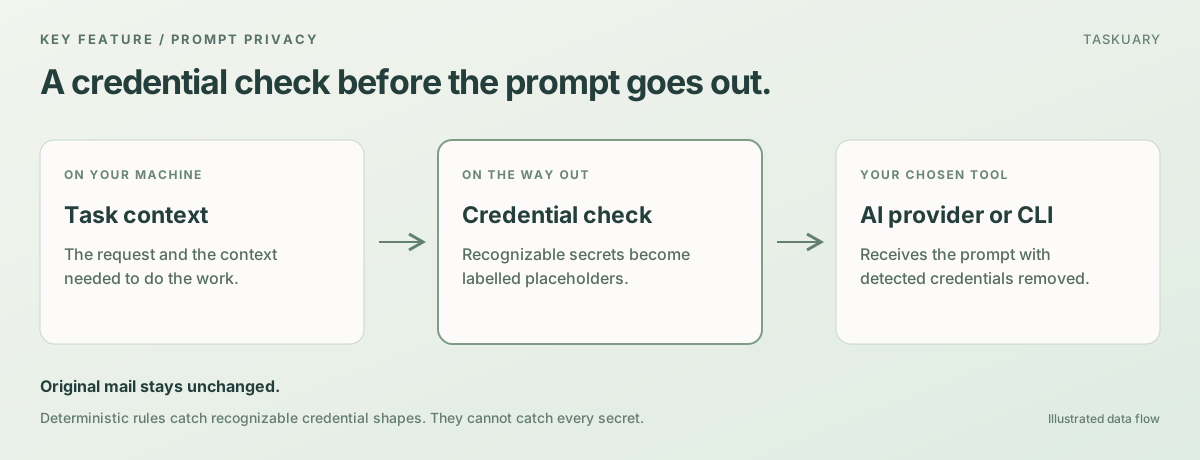
Taskuary runs locally. With a hosted AI provider or coding CLI, the prompt contains the context needed to do the work you asked for. Use a model running on your machine, and those AI prompts stay local too.
Credentials are taken out of that prompt first. If a colleague mails an API key, a connection
string, or a private key, it is replaced with a labelled placeholder ([redacted:aws-key]) at
each of the three doors a prompt can leave by: the hosted models, a headless CLI run, and the
first prompt of an agent pane. Your mail itself is never altered—the scrub is on the way out,
not on the way in—so a vendor's one-time code stays readable where it arrived. Nothing Taskuary
sends carries a placeholder either: a reply still holding one is refused, not delivered.
The rules are deterministic rather than a model's judgement, because by the time a model could judge, the credential would already be in a prompt. So they catch credentials with a recognizable shape—provider keys, tokens, credentialed URLs, connection strings, private keys—and they will not catch a sentence like "the wifi password is bluefish17". Report anything you find through SECURITY.md.
Download the latest single-file Taskuary.exe and open it. No Python or installer is required.
Python 3.10 or newer works on Windows, macOS, and Linux:
pip install taskuary
taskuary
Taskuary opens at http://127.0.0.1:7787. For a native desktop
window instead, install pip install "taskuary[desktop]" and run taskuary-desktop.
git clone https://github.com/ldbumble/taskuary
cd taskuary
docker compose up
Then open http://127.0.0.1:7787. Docker runs the web app; coding CLIs and the optional WhatsApp bridge remain on the host.
On first run, connect an AI provider or local Ollama model, add at least one inbound channel, then choose the coding CLI that should receive tasks. The setup wizards test each connection before it goes live.
taskuary --demo # or: docker compose --profile demo upThe demo is the real interface with fictional work and scripted replies. It cannot connect to outside systems, send messages, run tools, or start agents. Its changes reset when you reload.
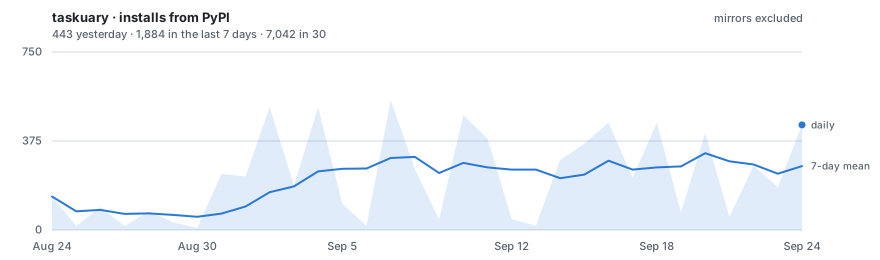
Updated daily from PyPI with mirror traffic excluded. The raw series is
downloads.csv on the stats branch.
The documentation is at taskuary.com/docs.
- Start here—installation, first run, Docker, and where your data lives
- How it works—the Timeline, the five roads, what triage decides, the operator documents
- Connections—channels, AI providers, work systems, and report sources
- Tasks and agents—the task, the agent work and the reply as three separate lives
- Reports and the Assistant—the report pipeline, AI-written source cards, and what Taskuary watches
- Settings reference—every setting, generated from the schema the app itself reads
- Status and roadmap—what works today and what is next
- Contributing—development setup and contribution guide
Taskuary is free and open source under the MIT License. Issues and pull requests are welcome; security reports belong in SECURITY.md.