
MoE inference in Rust, from the HTTP server down to the CUDA kernels.
DeepSeek-V4.1-Flash Q3_K_M on an RTX A6000 and a 32-core CPU: 29.66 tok/s decode at depth 6 and 30.04 at depth 4096, 358.4 tok/s prompt at P = 4096; provisional until the warm re-measure (conditions, all numbers).
- More than 200 CUDA kernels, all written in Rust with cuda-oxide (how).
- Experts on the GPU and the AVX2 CPU in one CUDA graph step.
- Adaptive residency: routed experts move between the card and the host by the engine's own routing as it runs.
- Speculative decoding with greedy output unchanged: DSpark for V4.1 (the draft on a second card), the MTP head for Qwen3.8 and GLM-5.3.
- A second card as an expert tier: V4.1, Qwen3.8 and GLM-5.3 put more routed experts on the RTX 3090 beside the A6000 (
--place bp). - V4.1's batched prompts leave the state of one step per token, bit for bit.
- A llama-server-compatible HTTP API for V4.1, Qwen3.8 and GLM-5.3, from one binary.
- A decision model: Cloudflare's Clef-Flash answers SystemOne requests (
POST /v1/systemone), its backbone on the card and its joint schema head on the host. - Every number comes from a runner and links its log.
| Model | File | Runs as |
|---|---|---|
| DeepSeek-V4.1-Flash | Q3_K_M (vcruz305) |
GPU + CPU experts; generate_ds41, bloomery-chat, bloomery-serve --model ds41 |
| GLM-5.3-Flash | UD-Q4_K_XL (unsloth) |
GPU + CPU experts; sparse attention past 2,051 positions; generate_glm5next, bloomery-serve --model glm |
| Qwen3.8-Flash-Next | UD-Q4_K_XL (unsloth) |
GPU + CPU experts; generate_qwen3moe, bloomery-serve --model qwen38 |
| Qwen3.6-35B-A3B | Q4_K_M (lmstudio-community) |
whole model on one GPU; generate_qwen3moe |
| Qwen3-30B-A3B-Instruct-2507 | Q4_K_M (unsloth) |
whole model on one GPU; generate_qwen3moe |
| Clef-Flash (Cloudflare, a decision model) | Q8_0 to Q3_K_S (bartowski: the Q8_0 file and eleven K-quant files), and the release's head file (how) |
whole model on one GPU, its head on the CPU; bloomery_serve_clef (POST /v1/systemone) |
| DeepSeek-V2-Lite-Chat | Q3_K_M (mradermacher) |
CPU or GPU; the first model, still gated |
Each file is the public upload as downloaded. For GLM-5.3, Qwen3.8 and Qwen3.6 the files were checked against the uploads on 2026-09-28 (every shard's size, the first shard's sha256); the others have no recorded sha256 check yet. Clef-Flash also needs its joint schema head, joint_head.safetensors, from Cloudflare's release.
The DSpark draft for V4.1 speculative decoding is not a public upload: it is converted from DeepSeek's V4.1 checkpoint with the converter in llama.cpp's V4.1 pull request, with dflash.target_layers set to [37, 38, 39] (the converter writes V4's [38, 39, 40]).
- Placement. Each layer starts with a fixed number of routed experts on the card, the lowest ids. With
--place bp, V4.1 puts the model on the A6000 and more routed experts (and the DSpark draft) on the 3090. Qwen3.8 runs its card share of the experts on the card (BLOOMERY_QWEN38_EXPERTS=card, the default); under--place bpits decode also serves routed experts from the 3090 as an expert tier; its prompt does not yet, so the Qwen3.8 server refusesbpat the first prompt. GLM-5.3'sgenerate_glm5nextand server take--place bpthe same way, with its MTP draft and adaptive residency beside the tier; its server's default stays--place auntil the two placements are compared in one run. - Adaptive residency. Under V4.1's serving placements (
--place aandbp), Qwen3.8's--place aand GLM-5.3's server at--place aandbp, the engine counts its own routing and swaps experts between the card and the host between steps (BLOOMERY_RESIDENCY, on by default there;generate_glm5nexttakes it when set). A prompt call also streams its hottest host experts into the card's pool (BLOOMERY_HOSTSTREAM: V4.1, and Qwen3.8'sgenerate_qwen3moe; the Qwen3.8 server does not take it yet), so decode starts on experts that fit the prompt. - Engram rows from NVMe. V4.1's engram table is read from NVMe, 48 rows a token, prefetched by a helper thread.
- Skewed pass. Speculative decoding runs two positions one layer apart in one step and verifies a draft token: the DSpark draft (
BLOOMERY_DRAFT=dspark) or an n-gram lookup (BLOOMERY_DRAFT=lookup). - MTP drafts. Qwen3.8's MTP head drafts a window of four rows and verifies it in one pass (
BLOOMERY_DRAFT=mtp, on by default under--place a); GLM-5.3's next-token layer drafts one token for a two-row verify (BLOOMERY_DRAFT=mtp, on by default in its server at--place aandbp;generate_glm5nexttakes it when set). - Batched prompts. V4.1 runs a prompt in batches of up to 512 positions, each expert over all its tokens at once, two batches in flight so the card and the CPU overlap. Qwen3-30B and Qwen3.6 run ubatches of up to 4096 tokens through an int8 tensor-core GEMM; Qwen3.8 runs ubatches of up to 4096 with its card experts beside the host tier; GLM-5.3 runs its prompt in batches, its sparse-attention selector included.
- Loading. A load streams the file's bytes to the card through a pinned ring with one sync; a warm V4.1 load takes about 16 s (rig-log).
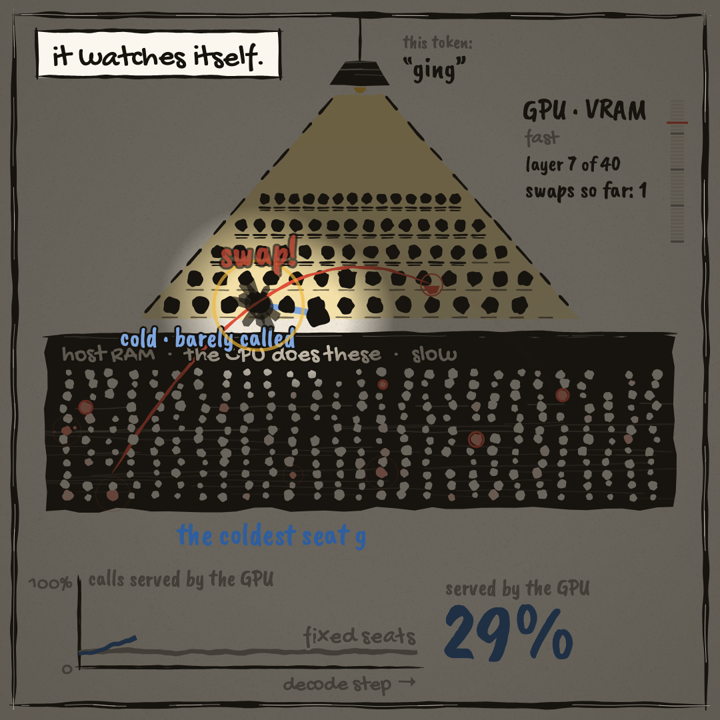
Adaptive residency on one A6000, V4.1-Flash Q3_K_M, 96 decode steps after a 512-token prose prompt: 29.48 tok/s with it off, 35.70 with the swap rule, 43.86 with the prompt call's streaming as well (the default). The card served 18 % of the routed calls with it off; with streaming it served 57 % over the first 16 steps and 71 % over the last 16 (rig-log; the video's source and a source for every number: tools/clip/residency).
V4.1 runs on the public Q3_K_M file as uploaded. generate_ds41 takes token ids and prints greedy ids; bloomery-chat streams text. bloomery-serve --model ds41|qwen38|glm serves llama-server's HTTP API, streaming, one request at a time; bloomery-serve-ds41 and bloomery-serve-qwen38 are its V4.1 and Qwen3.8 seats alone. The V4.1 server reuses a cached prompt prefix, splits reasoning and returns tool calls. The Qwen3.8 server keeps the longest prefix a request shares with its slot, back to the recurrent layers' last checkpoint, and holds another session's state in its host prompt cache (--cache-ram). The GLM-5.3 server keeps a slot's prefix back to its last checkpoint (every 512 positions) and has no host prompt cache. Qwen3.6 runs from its generator bin and has no server yet. bloomery_serve_clef answers Clef-Flash's SystemOne requests (text states), one at a time, and each response carries timings (prompt_n, prompt_ms, head_ms). The Qwen and GLM chat templates render as jinja2 does on their gates' cases, and the tokenizer is bit-identical to llama-tokenize on its gate's corpora.
In progress: the warm re-measure against llama.cpp (below); GLM-5.3's prompt front on the GEMM path; serving on N cards (two today) for every model, and Qwen3.8's prompt on the 3090 tier; concurrent batched decode across slots; Clef from bartowski's IQ, Q2_K and Q4_0/Q4_1 files; faster V4.1 host experts; DeepSeek-V4-Flash-0731.
All numbers are single-stream tok/s on the development machine: an RTX A6000 (48 GB, 300 W) unless a row says RTX 3090 (24 GB, 250 W), with a 32-core AVX2 CPU. Decode generates n = 96 tokens. Every number comes from the runners in tools/ref/ under the quiet-machine protocol, and each row links to its rig-log entry with the command lines. Every measured number, the other engines' rows and bloomery's progress over time are on the living benchmark page, rig-log docs/bloomery-bench.md, rendered from the runner logs after each sitting.
Placement (a): 2,668 routed experts on the card, 12,692 on the host. Against llama.cpp's V4.1 pull request #28696 at 5210c7c (-ngl 999 --n-cpu-moe 33 -fa on -t 32 -nopo 1), synthetic prompt ids, the id-prefix placement with adaptive residency off (it was not yet the default), one window; 2026-09-28, rig-log v41-release.
| A6000, tok/s | bloomery | llama.cpp | ratio |
|---|---|---|---|
| decode, depth 6 | 29.66 | 22.75 | 1.304 |
| decode, depth 4096 | 30.04 | 21.78 | 1.379 |
| prompt, P = 512 | 190.6 | 104.9 | 1.817 |
| prompt, P = 4096 | 358.4 | 76.5 | 4.68 |
This table is provisional. llama.cpp ran through llama-bench, which feeds new random ids on every repetition, so its rows read n-gram (engram) rows it had not seen through page faults, in every repetition at P = 4096; with repeated ids the branch ran at 103.8 there on 2026-09-25. Its prompt rows ran with op offload off only. A warm re-measure, with both engines on the same token ids and llama.cpp at its fastest flags, replaces it; the conditions are in docs/fair-measure.md.
| Model | Setup | Decode, tok/s | Prompt, tok/s | vs llama.cpp | rig-log |
|---|---|---|---|---|---|
DeepSeek-V4.1-Flash Q3_K_M |
A6000 + CPU, adaptive residency with prompt streaming (today's default), prose prompt | 43.30 after a prompt of 512, 36.77 after 4096 | 191.97 (P = 512), 376.67 (P = 4096) | not measured | callstream-pp-a |
GLM-5.3-Flash UD-Q4_K_XL |
A6000 + CPU, prose prompt | 20.95 (depth 512), 20.99 (depth 1024) | — | decode faster, but slower than its MTP draft; prompt slower | glm-release |
Qwen3.8-Flash-Next UD-Q4_K_XL |
A6000 + CPU, card experts, adaptive residency with prompt streaming and the MTP draft (today's default), prose prompt | 91.24 after a prompt of 512, 79.33 after 4096 | 861.7 (P = 512), 1,024.3 (P = 4096) | not measured | q38seed-ab |
Qwen3.6-35B-A3B Q4_K_M |
A6000, whole model | 204.4 (depth 6), 195.8 (depth 4096) | 6,464 (P = 512), 8,311 (P = 4096) | faster | q36-release |
Qwen3-30B-A3B-Instruct-2507 Q4_K_M |
A6000, whole model | 209.2 (depth 6), 175.2 (depth 4096) | 7,827 (P = 512), 9,276 (P = 4096) | faster; near par in decode at depth 4096 | qwen3-xeng |
- "vs llama.cpp" is the direction in the same window as the linked rig-log entry (decode and prompt alike unless it says otherwise): mainline llama.cpp, or the model's llama.cpp pull request. "Not measured" means that window had no llama.cpp rows. The rows from 2026-09-28 are provisional, as above.
- The V4.1 row is a two-round window of bloomery alone and the Qwen3.8 row a six-round one; decode follows the prompt it names. Qwen3.8 with card experts alone ran 53.85 / 53.47 decode and 659.2 / 618.2 prompt on 2026-09-29 (q38prose-pp); on 2026-09-28, with every routed expert on the CPU, it ran 40.46 decode and 104.0 prompt at P = 4096, slower than llama.cpp in that window.
- GLM-5.3's row fed its prompt one step per token (about 21 tok/s). Its batched prompt, its MTP draft and its adaptive residency have landed since; the draft and residency are its server's defaults at
--place a. No runner has measured them yet; a recording of the server is under More.
--place bp: the A6000 with the model and 2,668 routed experts, the RTX 3090 (250 W) with more routed experts. These rows do not share a table with the one-card rows.
| A6000 + 3090, tok/s | Decode | Prompt | rig-log |
|---|---|---|---|
| adaptive residency with prompt streaming, prose prompt | 44.28 after a prompt of 512, 37.45 after 4096 | 205.48 (P = 512), 388.93 (P = 4096) | callstream-pp-bp |
| Minimum | Extended | |
|---|---|---|
| GPU | RTX 3090 24 GB (sm_86) | an RTX A6000 48 GB with the RTX 3090 (--place bp) |
| CPU | AVX2, 8 DDR4 channels | same |
| RAM | 256 GB | same |
| Storage | NVMe for the engram table | same |
The development machine is a Threadripper PRO 5975WX (32 cores, 8 DDR4 channels, 264 GB) with an RTX A6000 and an RTX 3090. A card is picked by its name (A6000, 3090), so two RTX 3090s are not supported: make one visible with CUDA_VISIBLE_DEVICES. The CPU build targets Zen 3 (target-cpu=znver3); another CPU needs the flag changed (docs/BUILD.md).
Every throughput number in this README ran on the A6000: the one-card rows on the A6000 alone, the two-card rows on the A6000 with the 3090 (--place bp). No row ran on a 3090 alone yet; those rows come with the release re-measure. V4.1 decode is bound by host memory bandwidth, 135–137 GB/s at 32 threads. Costs per part: docs/HARDWARE.md.
- Against ik_llama.cpp. Intermediate tensors are dumped from ik_llama.cpp's CPU backend and compared per layer. Integer outputs (router ids, engram rows, indexer top-k) must match exactly outside tie bands; float outputs stay inside bands derived from both engines' rounding.
- Bit gates. Graph replay equals eager execution; the skewed pass equals two single steps; a rollback and a V4.1 batched prompt leave the same state as one step per token.
- PPL and KLD on the public V4.1 file (wikitext-2, 2048 context, 4 chunks, RTX 3090): PPL 2.2401 against ik_llama.cpp's 2.2378; KLD 0.00987 ± 0.00049; same top token 97.46 % (rig-log).
- Clef against Cloudflare's own Python. The request encoder's token ids and spans equal the release's
encode_recordon 14 requests (8 in the suite, 6 edge cases); the head's logits stay within 2e-5 of an f64 copy of the release's head on the release's own hidden states (just gate-decision-clef, references fromtools/ref/clef_ref.py). The backbone's hidden states are gated against llama.cpp mainline's final-norm rows (just gate-gpu-clef-hidden). End to end over 15 requests (8 English, 7 Korean), the top option equals the BF16 release's on 29 to 31 of 31 questions for every one of bartowski's files fromQ8_0(9.55 GB) down toQ3_K_S(4.26 GB), 31 of 31 for theQ6_KandQ5_Kfiles; every miss is a question the release itself answers within 0.02 of a tie or of 0.5. The table per file, with the probability gaps and the prompt rate:tools/ref/clef/agreement.md; the same table as a guide for picking a file: midagedev/clef-flash-bloomery. - Each gate is shown to fail on its defect before the fix lands. Bands are not relaxed to pass.
- sm_86 only. The
justrecipes andtools/box.share the maintainers' tooling for one remote workstation;docs/BUILD.mdgives the direct commands for your own host. - A pinned nightly (
nightly-2026-08-28) with a pinned cuda-oxide revision from our fork, where fixes wait for upstream (THIRD_PARTY_NOTICES.md). - V4.1 prompts are bound by the CPU expert tier: the host experts are most of each layer-batch.
- One request at a time in every server, one slot each. Qwen3.6 has no server yet.
- Clef takes text states only (no images or video), reads backbone weights of Q3_K, Q4_K, Q5_K, Q6_K, Q8_0 and F32 (not yet the IQ types, Q2_K, Q4_0 or Q4_1), and runs its head on the CPU.
- One tier card. The host tier serves at most one expert tier card today; the N-card structure is in progress.
- Qwen3.8 keeps the routed experts past its card share on the CPU, where adaptive residency moves them as it runs. Its MTP draft costs the prompt 3.1 % at P = 512 and 6.1 % at P = 4096 (rig-log).
See docs/BUILD.md: the toolchain, one command block per model (download, build, generate, serve, and --place gate on a single RTX 3090), and the CPU flag. In short: Linux x86-64 (the build targets Zen 3), CUDA 13.3, LLVM 21, Clang 21 and cargo-oxide from our cuda-oxide fork, then cargo oxide build --arch sm_86 -- -p bloomery-gpu-gates --features deepseek41 --release --bin generate_ds41 and BLOOMERY_REF_MODEL=<first shard> target/release/generate_ds41 --place gate --tokens 671,6102,294,8760,344.
- ik_llama.cpp: DeepSeek-V4.1 support (#2455),
GGML_CUDA_NO_PINNED_WEIGHTS(#2444), V4.1 DSpark drafts (#2522, #2546), and eleven more fixes, merged; #2507 and #2562 open. - cuda-oxide: #1314 and #1321 merged; #1329 and #1346 open. Unfiled toolchain issues:
docs/upstream/nvlabs-ledger.md. - llama.cpp #29008 merged; mistral.rs #2430 and cutile-rs #309 open.
- How bloomery uses cuda-oxide (layout, launch contracts, pinning):
docs/cuda-oxide.md. - Measurements and command lines: rig-log (Korean).
- Recorded sessions, not benchmark rows:
- V4.1 on two cards answering a coding review (507 prompt tokens, 1,500 generated): toktape.
- GLM-5.3's server on the A6000 alone, at its defaults (adaptive residency and the MTP draft), answering a coding review (497 prompt tokens, 2,000 generated): toktape. The same prompt through llama.cpp's GLM pull request with its MTP draft on the same card: toktape.
- Clef-Flash on the A6000 (a
Q4_K_Mconverted from the release) answering seven Korean SystemOne requests, 63 requests in all: 93.6 ms end to end at the median, 0 top options flipped against the release: toktape.
- Plan and cost models:
docs/plan.md; GPU design:docs/gpu-design.md; placement:docs/v41-placement.md(Korean). - Working contract:
AGENTS.md,CONTRIBUTING.md.
ik_llama.cpp and ggml are the numerical reference: the kernels were written by reading ggml's k-quant code and ik_llama.cpp's iqk_mul_mat, and accuracy is defined against their output. exllamav3 and mistral.rs are design references, cited where used. All four are MIT. The GPU kernels compile with cuda-oxide (Apache-2.0).
AI assistants helped write the code and the documentation. Every number here was measured by the runners in tools/ref/.
MIT, see LICENSE. crates/oxide-ice-unroll carries NVIDIA's Apache-2.0 headers. Third-party notices are in THIRD_PARTY_NOTICES.md.