
Use any web browser or WebView as GUI, with Elixir in the backend and modern web technologies in the frontend, all in a lightweight portable library.
Note
This binding is under development and has not yet been published to Hex.
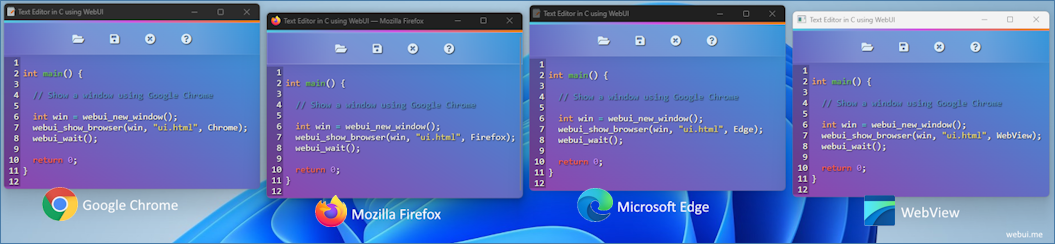
WebUI drives a browser you already have installed instead of bundling a browser engine, so applications stay small and portable. Your UI is HTML/CSS/JS; your backend is Elixir.
Unlike the other WebUI bindings, this one compiles a small C shim, so a C compiler is required. Erlang has no runtime FFI, so there is no way to call WebUI without one.
| Platform | Needs |
|---|---|
| Linux | gcc, make |
| macOS | Xcode command line tools |
| Windows | MSVC — see the note below |
One command fetches Elixir deps, downloads the WebUI static library for your platform, and builds the NIF:
mix setupImportant
On Windows, run this from a Developer Command Prompt for VS (or a shell
where you have run vcvarsall.bat). The build uses nmake and cl, which
are only on PATH there. From an ordinary prompt it fails with:
** (Mix) "nmake" not found in the path.
Prefer the steps individually, or already have the deps? They are:
bash bootstrap.sh      # Linux / macOS   (bootstrap.bat on Windows)
mix deps.get
mix compile
WebUI is linked statically into the NIF, so there is no webui-2.dll /
libwebui-2.so to ship or locate at runtime — priv/webui_nif.* is
self-contained.
To build against a local WebUI checkout instead of the released library:
WEBUI_DIR=/path/to/webui/dist WEBUI_INCLUDE=/path/to/webui/include mix compilewin = WebUI.new_window()
WebUI.show(win, ~S(<html><script src="webui.js"></script> Hello World! </html>))
WebUI.wait()
WebUI.clean()Every page must load <script src="webui.js"></script>. WebUI generates that
file in memory — you do not create it.
Bound functions appear in the page as async JS functions of the same name. The handler's return value resolves the Promise.
win = WebUI.new_window()

WebUI.bind(win, "add", fn e ->
  WebUI.Event.get_int(e, 0) + WebUI.Event.get_int(e, 1)
end)

WebUI.show(win, ~S"""
<html>
  <script src="webui.js"></script>
  <button onclick="add(2, 3).then(r => alert(r))">Add</button>
</html>
""")

WebUI.wait()
Responses cross to JavaScript as strings. Numbers, booleans and atoms are
converted for you; nil and :ok become "". Return structured data by
encoding it yourself:
WebUI.bind(win, "load_user", fn e ->
  e |> WebUI.Event.get_int(0) |> Users.get!() |> Jason.encode!()
end)WebUI.run(win, "document.title = 'Set from Elixir'") # fire and forget
{:ok, "42"} = WebUI.script(win, "return 6 * 7;") # wait for a resultscript/3 takes :timeout (seconds, 0 waits forever) and :buffer_size
(bytes, default 8192 — longer results are truncated).
Binding an empty element name catches all events on the window:
WebUI.bind(win, "", fn
  %WebUI.Event{type: :connected} -> IO.puts("connected")
  %WebUI.Event{type: :disconnected} -> IO.puts("disconnected")
  %WebUI.Event{type: :navigation} = e -> IO.puts("going to #{WebUI.Event.get_string(e, 0)}")
  _ -> :ok
end)See examples/.
Full documentation lives in the module docs — start at WebUI. The API mirrors
the C API with Elixir naming: webui_show → WebUI.show/2,
webui_set_size → WebUI.set_size/3, predicates as WebUI.shown?/1.
MIT — see LICENSE.